Showing posts with label society. Show all posts

Friday, March 11, 2011

Feminist anxiety and anxious feminism


On International Women's Day, the Globe and Mail published an extraordinarily frustrating and glib piece by Margaret Wente, who claims that "the war for women's rights is over, and we won." While I generally try not to take to take Margaret Wente seriously on any subject at all, and setting aside for a moment the fact that by 'we' she means upper-middle class white educated straight cisgender women living in North America (a vastly small subset of women to be sure), I found the following passage from the article particularly disturbing:
I owe everything to the gutsy women half a step ahead of me who battered down the barriers so that I could have it easy.
People who persist in looking for systemic discrimination against women in (name your field here) seem more and more desperate. They may as well complain about discrimination against male kindergarten teachers. We are finally learning that equality can also mean the freedom to make different choices. 
We're often told that feminists are strong women. Women who stand on their own making choices, without fear. Women who go out and get things done and don't let the world hold them back. Sometimes I feel like that kind of woman. But often I feel like a woman who can't always stand on her own, who needs to ask for help and support, and who spends undue amounts of emotional energy just trying to make it through tasks that other people find trivial. It took me almost an entire week to fortify myself before knocking on my advisor's door to introduce myself. It took me four long years to be able to eat in restaurants without feeling the need to bolt. And it still sometimes takes every effort I can manage to get up in front of a classroom full of students and talk to them about the sociology of sex. And there's a reason for that.

I have General Anxiety Disorder. This isn't an internet diagnosis, although the web did eventually help push me into a psychiatrist's office. I have a real life, no bones about it, certifiable mental illness. And often, before I started taking medication, it sucked.

Sometimes it sucked because struggling with terror over everyday things is frustrating. Anxiety the way I feel it doesn't feel like nervousness. It doesn't go away once something's been successfully completed or after I've had a good day. It just carries forward, transferred to the next thing that my amygdala has decided is deserving of my absolute and utter attention and concern. Depending on the day, I worry about work and school, friendships and relationships, eating in restaurants, the weather, and my health. On bad days, I worry about how much I'm worrying. On really bad days, I have panic attacks that relegate me to the couch or the bed, because doing anything but sitting and thinking my way out of a spiral of unreason is too much to contemplate. Or at least that's how things used to be. Medication, along with the support of family, friends, and a wonderful partner have helped alleviate the day-to-day vagaries of not being able to manage my own brain.

But sometimes my anxiety sucks for other reasons. Sometimes, it makes me feel like a bad feminist and a bad scholar. Neither of these things are true -- I happen to think that my struggles with anxiousness make me a better feminist and a better scholar most of the time. Like any other marginalized standpoint, I often feel as though I have the opportunity to see and empathize with experiences that are overlooked by much of the population. But that doesn't always transfer to how people see me. I know this, and it frustrates me.

The idea that feminism and disability intersect is certainly not a new one. The now defunct, but always excellent, FWD/Foward (Feminists With Disabilities) is an indispensable resource for understanding the various and complex ways that feminism confronts, supports--and sometimes clashes with--the needs and experiences of women with both physical and mental impairments. But we rarely hear these issues discussed in the press.

I was lucky enough to reach the height of my anxiety in an institutional setting where the costs of my seeing a doctor at one of the best anxiety clinics in the United States are covered for me. Moreover, I am fortunate to have parents who have never been anything but supportive of my decisions, and friends who I can turn to in times of need. But that I have these reinforcements available to me is a function of my privilege. This leads me back, once again, to an argument that I have made before: that the contemporary emphasis in public life on feminism as choice, rather than as justice, is harmful to the development of a feminist politics that advances the status of all women. For those women who do not have access to the resources I do, the choice to request and receive the tools necessary to improve their quality of life is not a choice at all. Similar to the difficulties that plague the quest for reproductive justice, the staggering lack of availability of mental health resources, particularly for women in marginalized communities is a roadblock in the ongoing struggle for women's rights. Moreover, the stigma attached to mental illness of in all of its forms, but particularly those illnesses that we tend to associate primarily with women and teenage girls, is a barrier to the idea that we need to take women's experiences seriously. Not only the experiences of those women who are in a position to expend their emotional, mental, and physical energies making leaps forward in the realms of business and politics, but also those women who spend their spoons on less public, more personal struggles.

Margaret Wente's unbelievably privileged assertion that feminism is over, on top of erasing the experiences of women worldwide, also neglects the fact that free choices can only be made in the context of a just society. For those of us who face the day-to-day frustrations and, yes, anxieties, of mental illness, the implication that we should just buck up and be happy because hey, if we could just manage to set foot outside the door we could be a CEO just like anyone else on top of the ongoing conflation of feminism with ballsy choice-making is unbearably aggravating. In order to move the cause of women, as well as other marginalized groups, forward, we need a reinvigorated public discussion that acknowledges that feminism is not just for go-getters. It is for everyone. And throwing the whole thing in the dustbin only makes living in this unjust society that much more anxious for the rest of us.

Wednesday, February 16, 2011

On fashion

Yesterday was a strangely fashion-oriented day for me. As a graduate student, it's a rarity that I have the opportunity that I have the time (or, more particularly, the money) to think a lot about clothes. I like clothes -- on long days I'm likely to be found perusing the sale rack at Urban Outfitters or picking through thrift store finds -- but I've never had enough money to buy all of the clothes I'd like. Overwhelmed with a sudden desire look look at summer dresses, I virtually window-shopped at Anthopologie and ModCloth, two stores that are generally far outside my meager pay grade. And they are about to get more so.

Jezebel, among other places, notes that the price of clothes is about to go up. Due to an increase in the price of raw materials, as well as higher wages for workers in Chinese factories (mostly caused by labour shortages, and not, unfortunately, unionization or legal regulations about fair labour practice), the price of clothes is expected to rise by 10% over the next few months, and more by the end of the year. While reading the post, I was struck by the multiple, intersecting problematics that clothing--and fashion more generally--pose for feminism.

The problem with the fashion industry (along with the cosmetics industry, and a host of other beauty-related consumer goods markets) is that it exists squarely at the interstice of vast networks of inequality and oppression. Many, if not most, workers in garment factories are women. They are paid subsistence wages (if that) to make clothes that they will never wear, unless, by chance, they happen to return to the country in the form of used clothing donations, which often devastate local textile industries. And buying "Made in America" doesn't mean too much either; in order to put the label on the clothing, all that is required is that the item undergo its final 'substantial transformation' in the United States. In practice, this has often meant that the clothing is made in sweatshops in US protectorates such as American Samoa or the Northern Mariana Islands, which are exempt from American wage and labour regulations. That the clothing can be offered at the low price we've come to expect in the post-industrial West is, in many ways, predicated upon the exploitation of workers (particularly women workers) in these territories.

At the same time, there are expectations of what is appropriate for women in Western culture to wear. Part of being a successful professional woman in North America is looking the part -- having the right suit, the right shoes, the right hair, and the right jewelery. On top of this, women's social locations are often, in part, constructed and represented through the clothes they wear. This is evident even in elementary school, where brand-consciousness is displayed by children of kindergarten age. Here class, race, and gender intersect to place demands on women to spend obscene amounts of money on beauty and fashion. In 2009, Newsweek published a graphic showing women's spending on beauty treatments (not including clothes) over the course of a lifetime. The projected amount spent? Almost half a million dollars. For those women who don't have the financial wherewithal to shop at high end stores, or even at mid-range popular shops like Anthropologie or J. Crew, the 'fast fashion' of Forever 21 and H&M is the difference between keeping on-trend or abandoning fashion to the dustbin of desires. Thrifting, often touted as the fashion maven's solution to high prices, is only possible if you have quality thrift stores within an accessible distance -- certainly not a guarantee anywhere but a big city -- and the time to pour over racks of items that may not have anything on them that fits, or only clothing that needs to be significantly altered before wearing. All of this adds to the price of fashion, and to the burden of women who shop.

To which many might say "so what?" Isn't fashion shallow and a ridiculous thing to be spending money on anyways? Wouldn't it be better if we all shopped at Goodwill and stopped caring about trends? Well, yes and no. In different social contexts, ignoring or pooh-poohing fashion is almost a trend in an of itself; the number of academics who walk around in muumuus and mom jeans is a testament to that fact. But the notion that fashion is unimportant, frivolous, or somehow inappropriate as a serious topic of conversation is evidence only of a discourse that systematically renders women's interests and activities as trivial. Thinking seriously about fashion means being able to confront the difficulties of clothing production, but also the bind of clothing consumption. Being fashionable, like having the right car, the right house, the right electronics, the right cell phone, and even the right taste in music, is a cultural marker. Its meaning is socially constructed, but that doesn't make it any less real for the women who are facing the social consequences of not looking 'right'. Owning clothes that look 'right', like owning a home, is part of our construction of what a successful life looks like. Fast fashion, while not of the same quality as higher-end clothing, allows women to participate in the exchanges of meaning that form the milieux of contemporary Western social life.

By choosing to work towards a PhD in the social sciences, I've had the opportunity to extricate myself in some ways from this tangle. As previously noted, academics aren't known for their fashion sense, and if called on my poor masquerade as an academichic fashionista, I can always fall back on a Marxist feminist critique of the beauty industry. The thing is, I don't want to. I like fashion. I like nice clothes and pretty things. I enjoy the process of shopping and putting together outfits (whether or not I'm good at it is a different question altogether). And I'm lucky enough to have a lifestyle where I can do all of those things, and yet still have the option to abandon it entirely should my finances take a turn for the worse. But my situation is unique; there are not a large number of careers where opting out of fashion entirely is an option. Even in those situations where it is a possibility, we all go home at night, and out with friends and lovers on the weekends. To be unable to participate in the cultural narrative of the fashionable woman is to be ill-equipped to move in and out of various social fields. This is true not only of mainstream consumption cultures, but also subcultural groups where clothing and adornment practices play a central role in allowing an individual to be recognized as a peer.

Like other common experiences primarily gendered female, struggling to think through the rock and the hard place of clothing production and consumption is an opportunity to observe the intersectionality of privilege and power in everyday life. By purchasing fast fashion, we engage with the exploitation of women's labour worldwide. By spending huge amounts of money on something as transient as trendy clothes and makeup, we participate in a culture that encourages the collection of assets by men, and the collection of debt by women. By suggesting that people simply "save up" to buy better quality (and 'exploitation-free') garments, we whitewash the elements of class and privilege that are deeply embedded into the world of women's consumption. And by disengaging from the discourse and practice of fashion entirely, we close off avenues of power, respect, and recognition that would otherwise be open to us, on top of displacing routes of fulfillment and happiness (feeling pretty is one of life's pleasures) that we should not have to reject in order to be 'properly' feminist or political. Ultimately, the uptick in clothing prices points us toward the intersections of privilege and inequality that characterize womanhood in a globalized society, without providing any easy answers for those of us who are just trying to get through the day and feel okay about how we look while doing it.

Friday, January 14, 2011

Ambiguous Utopias: the Science Fiction of Ursula K. LeGuin

As a long time fan of Ursula K. LeGuin, I am almost embarrassed to admit that it's taken me this long to read The Dispossessed, one of her most lauded novels (both in science fiction circles and outside of them).

Winner of the 1974 Nebula Award, as well as the 1975 Hugo and Locus awards, The Dispossessed is at once a sci-fi exploration of alien social worlds, and a philosophical exploration of our own. The novel is set on two neighbouring planets: Anarres and Urras. The inhabitants of these planets were once one people, but in order to prevent an anarcho-syndicalist worker's rebellion, the states of Urras grant the revolutionaries the right to settle on the barren, harsh moon of Anarres, with a promise of non-interference; all of this occurs approximately 200 years before the events of the novel. Anarres maintains an anarchist system of social organization, while Urras is more familiar--state governments, from capitalist-patriarchal to authoritarian-socialist vie with one another for global dominance.

We enter the dual worlds alongside the protagonist, Shevek, a Anarresti physicist who is making the first ever trip by a citizen of Anarres back to Urras. The novel's structure mirrors Shevek's disorientation; every even numbered chapter takes place on Anarres, detailing Shevek's past, while each odd numbered chapter follows his experiences on Urras. This device manages to maintain suspense in two timelines at once--why does Shevek leave Anarres? And does he ever come back?

As in many of her genre books, LeGuin's taught writing and well-rounded characters keep the novel moving, but it is the setting that takes centre stage. The subtitle of the The Dispossessed is "an ambiguous utopia", and this is a telling signifier. The world of Anarres--which could easily be a vicious caricature of anarchist ideas or an uncritical and unrealistic utopia--is, in LeGuin's capable hands, a fully developed social world. Its populace is not unrecognizable; there is vice and avarice, as well as love and altruism. Its materiality is harsh and unforgiving; Anarres is consistently described as a bleak desert landscape, bereft of plants and animals, as well as of magnificent architecture and labour-saving technology. But the characters are warm and believable, and their personalities clearly structured by their membership in a world where ownership is unknown and the worst thing you can be is an "egoist" or a "propertarian".

LeGuin has often been critiqued on for this detail-oriented focus on world building. For science fiction novels, her works display a surprising lack of space battles, hi-tech weaponry, and even significant action sequences of any kind. Despite this, they remain compelling. My interest in LeGuin's work is less about the characters or the plot, and more about her complex--sometimes dauntingly so--explorations of social worlds that, despite being set on alien planets, so closely mirror our own.

The daughter of a prominent anthropologist (Alfred L Kroeber, founder of the Department of Anthropology at Berkeley), LeGuin has noted in multiple places that her fiction has been deeply influenced by anthropological and social thought, as well as her encounters with her father's subjects of study. The Dispossessed is not the only novel of LeGuin's that deserves to be labelled an ambiguous utopia. Her most well-regarded work, The Left Hand of Darkness, describes a planet on which where is no gender. The Telling is set on a world where nature has been subsumed by technology, and The Word for World is Forest is a novella about the clash between a logging colony and the indigenous inhabitants of the planet they share (sci-fi critic Gary Westfahl, in his excellent review of James Cameron's Avatar said that the film most closely resembled LeGuin's novella, out of all its possible predecessors). Perhaps the most beautiful, and disturbing, is LeGuin's short story "The Ones Who Walk Away from Omelas"; which is absolutely worth the twenty minutes it takes to read it online.

What all of these works have in common, and what makes LeGuin's writing so endlessly compelling to me, is that they all share a common commitment to exploring anthropological and sociological ideas. In her essay "A War Without End", LeGuin writes:
In the sense that it offers a glimpse of some imagined alternative to 'the way we live now', much of my fiction can be called utopian, but I continue to resist the word. Many of my invented societies strike me as an improvement in one way or another on our own, but I find Utopia far too grand and too rigid a name for them. Utopia, and Dystopia, are intellectual places. I write from passion and playfulness. My stories are neither dire warning nor blueprints for what we ought to do...To me the important thing is not to offer any specific hope of betterment but, by offering an imagined but persuasive alternative reality, to dislodge my mind, and so the reader's mind, from the lazy timorous habit of thinking that the way we live now is the only way people can live. It is that inertia that allows the institutions of injustice to continue unquestioned.
 By displacing these alternative societies to alien planets, LeGuin allows the reader to accept these ideas as she presents them; a story similar to the one told in The Dispossessed could not be set in the present day, nor the recent past, and maintain its effect. Always nuanced and rarely didactic, The Dispossessed presents the anarchism of Anarres as a real political possibility--with all the flaws and vagaries that come with human social life--in a way that a novel set on Earth never could. Divested from the baggage of the Cold War, and yet subtly pointing towards the politics of that era, The Dispossessed explicitly recognizes the ambiguity of the characters utopias. In a passage toward the end of the novel, Shevek discusses his time on Urras with an ambassador from a future Earth:
"There is no way to act rightly, with a clear heart, on Urras. There is nothing you can do that profit does not enter into, and fear of loss, and the wish for power. You cannot say good morning without knowing which of you is 'superior' to the other, or trying to prove it...There is no freedom. It is a box--Urras is box, a package, with all the beautiful wrapping of blue sky and meadows and forests and great cities. And you open the box, and what is inside it? A black cellar full of dust, and a dead man. A man whose hand was shot off because he held it out to others. I have been in Hell at last. Desar was right; it is Urras; Hell is Urras."
For all his passion he spoke simply, with a kind of humility, and again the Ambassador from Terra watched him with a guarded yet sympathetic wonder, as if she had no idea how to take that simplicity.
 "We are both aliens here, Shevek," she said at last. "I am from much farther away in space and time. Yet I begin to think that I am much less alien to Urras than you are... Let me tell you how this world seems to me. To me, and to all my fellow Terrans who have seen the planet, Urras is the kindliest, most various, most beautiful of all the inhavited worlds. It is the world that comes as close as any could to Paradise."
The structure of the novel facilitates this ambiguity, with the final chapters detailing Shevek's escape from capitalist Urras, as well as his decision to leave anarcho-syndicalist Anarres in the first place. All the while, it is clear that while the material relations of the world make the man, it is his human relationships that make the world home.

Another passage in the novel captures LeGuin's commitment to both the intimacy of day-to-day social relationships, and the broader impact that these relationships have on the shape of collective social life:
"If you can see a thing whole," he said, "it seems that it's always beautiful. Planets, lives... But close up, a world's all dirt and rocks. And day to day, life's a hard job, you get tired, you lose the pattern. You need distance, interval. The way to see how beautiful the earth is, is to see it as the moon. The way to see how beautiful life is, is from the vantage point of death."
"It is sad", LeGuin writes in 'A War Without End', "that so many stories that might offer a true vision settle for patriotic of religious platitude, technological miracle working, or wishful thinking, the writers not trying to imagine truth...We will not know our own injustice if we cannot imagine justice. We will not be free if we cannot imagine freedom. We cannot demand that anyone try to attain justice and freedom who has not had a chance to imagine them as attainable." Despite the alien settings of her novels, LeGuin's work renders imaginable worlds where social life is organized differently, and, in doing so, allows us the opportunity to re-imagine our own.

Wednesday, December 15, 2010

On eating


So I came across this post today, through a long circle of links upon links upon links, and it really hit hard for me. The post is from 2006, but it clearly is still relevant now. I think the advice in it is vitally important, and not just for when you're around people who might/do have eating disorders.

It was two things in the post (and the comments) that really got to me. One was this (italics in the original, bolding by me):

Model comfortable eating. Cook for them. Invite them over for dinner. Take them out to dinner. Make them pancakes or waffles for breakfast. Stop for snacks. Carry snacks. Go to farmer’s markets and festivals. Start potlucks or movie marathons or bakeoffs. Engage in activities which build appetite, like hiking or long walks on the beach. Make eating routine. Make cooking artful. Connect it to good company and conversation. Create safe space for food.

On the other hand, Calm down. Do not press food on your friends. Do not make your friends feel guilty for refusing food. Do not override their decisions about what, when, and how much they will eat. Do not scrutinze their portions or their leftovers. Do not harangue them about starving themselves, or make passive-aggressive comments about how they eat like birds. Most women are humiliated by this treatment; women with full-blown eating disorders live for it.

And this one, from a guy in the comments:

When I was dating, I used to worry about the women who would order small and eat sparsely: “Is she worried about becoming what she sees as ‘too fat’? Does she think eating is unladylike (and if so, what other sensual pleasures does she consider herself unworthy of)? If we end up in a relationship, am I going to have to put up with this three times a day?” This has nothing to do with a woman being at a particular size.

I want to come back to these in a minute, because I think the guy in the comments is missing something vital that is in the original post, and it's something that is integral to my own experiences. Which I will now elaborate, in order for this to make sense.

For five and a half years, I struggled with disordered eating (rather than an eating disorder). I was never anorexic, bulimic, or body dysmorphic--my "eating problem" (which is what I still call it) stemmed from social anxiety rather than from body image. When I was in public, when I was with friends, and even sometimes when I was with my family, I felt like I was constantly being evaluated by everyone else in the room. But the manifestation of that social anxiety in my relationship to food and eating specifically is, I think, is directly related to the discourses and social practices that also play a causal role in a whole host of body- and eating-related disorders.

For as long as I can remember, I have been skinny. I was skinny when I was six, I was skinny when I was 12 and I was skinny at 18 when I left for university. I'm still skinny now. I use the word skinny because I am not just thin--I am boney and often knobbly and I don't have many curves to de-emphasize that. When I was a kid, I didn't really care about it. I actually don't think I ever really noticed, until one day in grade five, a friend of mine told me that I was an anorexic. She said her mom said that skinny girls were anorexic and that they hated their bodies, and her mom was a nurse so she should know. At the time, I ate a lot and played soccer and ran around on the playground, so I told her her mom was full of it and that I wasn't. But I remember that moment distinctly, because it was the first in a long line of moments where my body and my eating habits were subject to scrutiny. I have received comments from friends and from teachers, from employers and colleagues, from significant others and from family members. And this is to speak nothing of the media, which consistently tells women that their bodies can never be good enough.

I didn't start out a disordered eater. I was picky eater, but I ate enough and until I was full, and I ate loads and loads of snack food as soon as I figured out how to sneak into the kitchen when my parents weren't looking. I just never weighed a lot. And even that would have been ok, because this society tells women that they shouldn't weigh a lot, that they shouldn't weigh a normal amount, and that they shouldn't really weigh anything at all. So I fit into that mold, just by genetic happenstance. Being thin exempts me from the effects of living in a world where "attractive" doesn't mean me. But it doesn't exempt me (or any woman) from living in a world where our bodies are up for public scrutiny at any time. And while I might have ended up with a social anxiety about public speaking or meeting new people, I didn't get those. My--sometimes overwhelming--anxiety was directly attached to eating, specifically in situations where people could see me or watch me. The anticipation of eating in public was enough to make me nauseous and lightheaded, because people would be watching me and evaluating me. And because I was so anxious I couldn't eat, and because I couldn't eat people thought I was anorexic, and because people thought I was anorexic, I got more anxious. While I'm in a much better place now than I used to be, there are still situations, comments, and moments in which I am completely overcome with anxiety in relation to food.

So what's the connection between this personal narrative and body image related disorders? I think it can be seen quite easily in quote from the guy who commented on the Feministe post. This man, whose comment went on to say that he was worried his stepdaughter would develop body image issues because of the culture we live in, opened his comment saying that he worried about women who ordered small and ate sparsely. He wanted to know if they were worried they would appear unladylike or fat, and he pondered whether he would have to "put up with this" at every meal. And this is where the problem is. Whether we are fat or thin or somewhere in between, whether we eat salads or hamburgers or steaks or soup, and whether we like our bodies or we don't, our bodies are always up for public comment and judgement. If we are thin, it's because we are anorexic or bulimic; if we are fat, it's because we're lazy or we're slobs or we don't "care enough" about our "health". Women's bodies (and our eating habits along with them) are subject to constant media scrutiny, to constant social scrutiny, and to the scrutiny of those closest to us. And we're not allowed to forget it, because if we eat "too little" someone will comment, and if we eat "too much" someone will comment, and if we don't eat the right food, someone will comment, and if we avoid the situation entirely, someone will comment. Hell, if we walk down the street, someone will comment.

That's what I loved about this article: it doesn't just apply to ways of talking or dealing with people who have body image issues or eating disorders or whatever crazy mishmash I had going on. It applies to everyone, all the time. Modeling comfortable eating is something we should all do, for everyone. We shouldn't press food on our friends, or sanction them for eating what we think is too much. We shouldn't comment on portion size or tell someone to eat (or not eat) a sandwich or try to underhandedly evaluate whether or not their choice of a salad (or a cheeseburger) reveals something sordid about their personality or their mental health. And most importantly, we shouldn't talk about weight so damn much, at least not the way we do right now. Not our own weight (unless in a safe, supportive context) and not about other people's. Certainly not about the weight and eating habits of strangers. Because part of--and it's definitely not the only cause, but it's at least significant--the reason that we have body image issues, and part of the reason we have eating disorders, and part of the reason I didn't want to eat in public is because we know, even before it happens, that we are always already up for evaluation and judgement. And we all know that in this society when women (and especially their bodies and bodily practices) are up for judgement, they very rarely come out on top.

Tuesday, December 7, 2010

James Schell on games and real life


Carnegie Mellon professor Jesse Schell on the intersection of games and real life. He starts at Farmville and ends up somewhere entirely different. I recommend watching the entire half-hour -- the takeaway from the talk is not what you'd expect at the beginning, and part of the enjoyment of the video is watching him get there. The future he imagines is both terrifying and appealing, and, I think, also very possible. Definitely worth the watch.

Monday, October 18, 2010

Book Review: Thinking Sociologically


I've spent the last few days with food poisoning and scrambling to catch up with work, but in that period of time I had the chance to read Zygmunt Bauman & Tim May's Thinking Sociologically.

Like the academic nerd that I am, I'm always on the lookout for good introductions to sociology that I can recommend to folks, either to undergrads who want a slightly more in-depth explanation of the discipline, or to friends and family members who I want to torment with demands that they have at least a basic understanding of what it is that I do (although the latter has yet to actually work on anyone). My go-to book in the past has been C. Wright Mills' classic The Sociological Imagination, and though it's still a favourite, the middle chapters are getting slightly dated. Most sociology students these days never have an encounter with the work of Talcott Parsons or Karl Lazarsfeld; as entertaining as Mills' critiques of these mid-century giants is, its borderline irrelevant to the incoming generation of sociology students.

On the other hand, most introductory sociology textbooks follow the tried and true "subfields" method of organizing the discipline: a chapter on stratification and inequality, a chapter on race and gender, a chapter on organizations, a chapter on social movements, and so on and so forth. I've always hated those textbooks for two reason. First, they orient the mental frameworks of students toward dividing sociology into neat little categories that don't intersect. In my view, this promotes an extraordinarily atheoretical attitude among sociology undergrads (as well as some sociology professionals!) and relegates classical sociological theory to the dustbin of irrelevance, mostly for being 'too broad'. Second, they're often brutally out of date when it comes to introducing readers to up-and-coming theoretical perspectives. I've only very rarely seen intro texts that provide a place for network theory, for questions about risk, or for ethnomethodological or dramaturgical approaches -- most texts don't seem to know what to do with a Garfinkel or a Goffman, and so leave them to the sidebars. This isn't the only way to approach introductory sociology, but it seems to be the dominant organizational strategy in North America -- particularly in the United States.

Bauman and May eschew this approach in favour of a looser organizational style. Thinking Sociologically is divided into two substantive parts -- "Action, Identity and Understanding in Everyday Life" and "Living our Lives: Challenges, Choices and Constraints". Under these headings are chapters like "The Bonds that Unite: Speaking of 'We'", "Time, Space, and (Dis)Order", and "The Business of Everyday Life: Consumption, Technology, and Lifestyles". Each chapter deals with two or three major theorists who touch on these topics (broadly construed), as well as pointing the reader towards other work -- both traditionally sociological work and pieces from other social science disciplines -- that expands on the themes of the chapters. I found myself extremely happy to turn to the back of the book after Chapter Five (on gifts, exchange, and intimacy) and find both Ulrich Beck's Risk Society and Arlie Hochschild's The Managed Heart as recommendations for further reading. In a traditional US sociology text, the Hochschild book would end up in the "Gender" chapter, and the Beck book probably wouldn't appear at all.

My favourite part of the book, though, is that it actually follows through on the promise of the title. Like The Sociological Imagination before it, Thinking Sociologically focuses on what it means to approach questions in a sociological way. Rather than bounding the discipline by providing a list of "sociological" topics, Bauman and May spend the introduction exploring the idea that what makes sociology different from the other social sciences is not its subject matter, but rather its way of thinking about the world. Toward the end of the introduction, Bauman and May write:

Sociology stands in opposition to the particularity of worldviews as if they can unproblematically speak in the name of a general state of affairs. Nor does it take-for-granted ways of understanding as if they constituted some natural way of explaining events that may simply be separated from historical change or the social location from which they emerged...It demonstrates that the common metaphor of the motivated individual as they key to understanding the human world -- including our own, thoroughly personal and private, thoughts and deeds -- is not an appropriate way to understand ourselves and others. To think sociologically is to make sense  of the human condition via an analysis of the manifold webs of human interdependency -- that toughest of realities to which we refer in order to explain our motives and the effects of their activation.

May and Bauman focus on the power of sociology to be an antifixating discpline, one which "renders flexible what may have been the oppressive fixity of social relations", thus widening the scope of human freedom. This is an emphasis which is sorely lacking in mainstream sociological texts, for reasons unclear to me. In representing sociology as a domain of widened possibility, rather than as a stringent set of areas to be studied, Bauman and May make thinking sociologically relevant to non-specialists as well as professional sociologists.

In The Sociological Imagination, C. Wright Mills lays out a project for sociology:

The sociological imagination enables us to grasp history and biography and the relations between the two within society. That is its task and its promise. It is the characteristic of Herbert Spencer--turgid, polysyllabic, comprehensive; of E.A. Ross--graceful, muckraking, upright; of Auguste Comte and Emile Durkheim; of the intricate and subtle Karl Mannhein. It is the quality of all that is intellectually excellent in Karl Marx; it is the clue to Thorstein Veblen's brilliant and ironic insight, to Joseph Schumpeters's many-sided constructions of reality; is is the basis of the psychological sweep of W.E.H. Leckey no less than of the profundity and clarity of Max Weber. And it is the signal of what is best in contemporary studies of man and society. 
...
In large part, contemporary man's self-conscious view of himself as at least an outside, if not a permanent stranger, rests upon an absorbed realization of social relativity and of the transformative power of history. The sociological imagination is the most fruitful form of this self-consciousness. By its use men whose mentalities have swept only a series of limited orbits often come to feel as if suddenly awakened in a house with which they had only supposed themselves to be familiar. Correctly or incorrectly, they often come to feel that they can now provide themselves with adequate summations, cohesive assessments, comprehensive orientations. Older decisions that once appeared sound now seem to them products of a mind unaccountably dense. Their capacity for astonishment is made lively again. They acquire a new way of thinking, they experience a transvaluation of values: in a word, by their reflection and by their sensibility, they realize the cultural meaning of the social sciences.
Thinking Sociologically is a work that fits squarely in the tradition of Mills' project, and in that capacity, I wholeheartedly endorse it.


Monday, September 27, 2010

The language of choice and the politics of justice

About a week ago, a friend of mine posted, without comment, a link to this interview on whether porn has 'hijacked' our sexuality on her Facebook page. Now, as when I first commented on the article, I'm not going to take up a position on the question in the title. Instead, I'd like to pull out a quote from the middle of the interview that gave me pause: 
"...we need to have feminism with politics. And what's happened, I think, is that politics have been bled out of feminism, so now you get this idea that we got what we wanted, or at least we can be empowered as individuals. I'm sorry, but you cannot be empowered as individuals when women as a group are systematically discriminated against."
The idea of a feminism with politics is one that I've been thinking about for a while now. I came to my feminism through two distinct routes: academia and pop culture. In academia, I read and wrestled with writers from Mary Wollstonecraft through Simone de Beauvoir, through Catherine MacKinnon and the second wave, through bell hooks, Patricia Hill Collins, third wave theorists of sexuality, and post-structuralists like Butler and Haraway. In pop culture, I read and enjoyed Bitch and Bust, watched Buffy and Battlestar Galactica, read novels about women knights and watched indie romantic comedies with quirky female leads.

My feminism during those years was essentially an applied version of a de Certeauian strategies/tactics model: if I was encountering oppressive ideology through the media and products I consumed, then I was going to resist that ideology through alternative readings of pop culture products, through parodic presentation of self, and through a general attempt (if poorly articulated) to be a feminist by consuming in what I felt was a feminist way. Watching sexist television was somehow a political act if I knew that it was sexist and enjoyed it ironically.

During my final year of undergraduate education, I read three books that changed my thinking. The first was Nancy Fraser's Justice Interruptus. The second was Steven Lukes' Power: A Radical View. And the third, and most important for me, was Iris Marion Young's Justice and the Politics of Difference. All three books have a uniting factor: they talk about women's rights in the context of justice, rather than the context of choice.

Choice is the cultural keyword in contemporary Western feminism. It's also a concept easily appropriated  for the purposes of frustrating feminist concerns. While free and open choice is an admirable goal, and one that I am deeply in favor of folding into a justice-centered feminism -- after all, what is justice without choice? -- I am also wary of making it the end goal of feminist politics. This wariness stems from, and is subsequently directed towards, two sources. First, I am concerned about the supposed authenticity of choice and it's relationship to non-domination. In this case, my critique is directed towards  intellectuals, feminist or not, public or not, who valorize choice without taking into account the notion that preferences are or can be (de)formed. Second, I am concerned about the relationship between choice and consumption. This is a critique levelled more directly at myself and other women of my generation, who have often found ourselves expressing our feminism through the things we buy and the media we consume, without much visible thought about the relationship of consumption to the oppression of women.

In her work on sex and social justice, Martha Nussbaum introduces the concept of 'preference deformation'. Using a definition of preference that encompasses desires, emotions, and appetites, Nussbaum argues that liberal thought has traditionally accepted the idea that preferences can be distorted, and that these distortions can affect choice. The question for feminism, is in how we relate choice to freedom. In Power: A Radical View, Lukes argues that there are some views of freedom in which being free is defined as a lack of interference in the realization of my preferences, whatever they happen to be. On this view, says Lukes, "then how my preferences are formed, how my judgements are made and what influences them -- none of this has any bearing on the extent of my freedom". If, on the other hand, my preferences are distorted by the operation of ideology, than my freedom cannot be found simply in the exercise of choice. In the introduction to Throwing Like a Girl, Iris Marion Young questions the non-ideological nature of 'authentic' experience:
Often people seem to assume that if we express our authentic experience, we will be free of ideology and the false impressions of society that lead to conflict and irrationality. But this is clearly not so: ideology operates, or interpolates, as Althusser says, at the most immediate level of naive experience. 
This is fundamentally a critique of a liberalism that argues feminist critiques have been addressed as long as women are the ones 'choosing' what their lives look like; either abstractly, through participation in democratic politics and capitalist markets, or concretely, through the choice to have children or not, to enter the job market or not, etc.

In her book The Aftermath of Feminism, feminist cultural theorist Angela McRobbie expresses a different problem with the language of choice. She writes the following in the introduction:
Elements of feminism have been taken into account, and have been absolutely incorporated into political and institutional life. Drawing on a vocabulary that includes words like 'empowerment' and 'choice', these elements are then converted into a much more individualistic discourse, and they are deployed in this new guise, particularly in media and popular culture, but also by agencies of the state, as a kind of substitute for feminism...There is a kind of exchange, and also a process of displacement and substitution going on here. The young woman is offered a notional form of equality, concretised in education and employment, and through participation in consumer culture and civil society, in place of what a reinvented feminist politics might look like.
Here the critique is leveled at a hegemonic culture that appropriates the language of choice, and substitutes consumerism for justice. But McRobbie also takes a long, hard, look at herself in the mirror. For feminists invested in pop culture or ironic expressions of femininity, the question remains as to whether or not buying the right clothes, wearing (or not wearing) the right lipstick, and reading the right books and magazines are feminist acts. Moreover, in a culture where young women are reluctant to call themselves feminists, but readily embrace the notion that purchasing is activism, where can we locate a politics of justice for women who are on the margins of the capitalist system?

Whatever wave of feminism we're currently on needs to revisit its thinking on individual choice in the context of larger structures of domination and oppression. I don't know at what point the opposite of oppression became choice, rather than justice. The thing is, "but she/I chose it" just isn't good enough for me in a world where we manage to recognize structural constraints and active ideology everywhere but in our own personal lives.

More on in a similar vein on Feministe; the author explores the language of choice vs. the language of justice in the context of reproductive politics. Particularly salient and very much worth reading is amandaw's comment: "'Choice' never bothered to look beyond the in-group and see whether their problem was even the same problem other people faced."

Tuesday, September 21, 2010

Cartography again (last time, I swear!)

I spent a large amount of time this morning watching clips of The West Wing on YouTube. When I was in high school, The West Wing was probably my favourite show -- it was smart, political, funny, and dramatic, and never got bogged down in the melodrama of the characters' personal lives at the expense of the larger political action. If I had $200 to spare, I'd lay down money for the complete series box set any day.

One of my favourite early episodes focuses on "Big Block of Cheese Day", when the White House staff members listen to the concern of members of the public who usually don't get the ear of the White House. C.J. Cregg gets stuck with Cartographers for Social Equality, resulting in one my all time favourite scenes:


Nothing is where you think it is! This reminded me of the post I made yesteday on radical cartography and the visualization of social issues. Every once in a while, a weird academic issue like map projections makes it into pop culture. Enjoy!

Monday, September 20, 2010

Radical cartography and neighbourhood segregation

Here's a fascinating post from Gawker about racial neighbourhood segregation in the top forty US cities. Using 2000 census data, photographer Eric Fischer, create the maps, where one dot represents twenty-five people. The dots are color coded based on race: pink is White, blue is Black, yellow is Hispanic, and green is Asian-American.

As a temporary Michigander, I often hear a lot about the racial divide in Detroit. Even folks who have never been to Detroit know about the infamous Eight Mile divide between the white suburbs and the black inner city. But never have I seen it so starkly illustrated as in this map:

Racial segregation in Detroit. The blank area to the right of the middle
is Dearborn. The artist clearly didn't choose a colour for Arab-Americans.
Some of the other maps created have interesting anomalies. This map of San Francisco and the Bay Area has a small circle of dense Black and White (blue and pink dots) in the upper right corner:


Racial segregation in San Francisco & the Bay Area.
That dot represents San Quentin State Prison, California's oldest prison and only death row for male inmates -- the largest in America. 

These maps provide the same information as Census date, but because of the mode they use to present it, they impact the viewer in a very different way. I'm a big proponent of information aesthetics -- I hate bad infographics more than I hate PowerPoint. Sometimes I just like graphs because they're beautiful, or because they're useful. These maps are both, but they're also something else -- political.  Projects like Radical Cartography redefine our understanding of what maps are for in a way that challenges our ideas about what demographic data (among other types) can tell us about our society at large. Maps like these challenge us to understand neighbourhood segregation that takes into account the particular histories of different cities, while still demanding that we sit up and pay attention.

David McCandless, author of Information is Beautiful and The Visual Miscellaneum, recently gave a TED Talk on the possibilities of data visualization in a world where we are often threatened with 'information overload'. Check it out:


Sunday, September 19, 2010

Badass Women of History: Matilda Joslyn Gage

Matidla Josyln Gage, radical feminist
One of the best things about reading the history of obscure topics is discovering historical figures who you had no idea existed, despite the fact that they were probably fairly well known (at least in some circles) in their time. My recent discovery, while reading the aforementioned Making Technology Masculine is Matilda Joslyn Gage. Radical women's rights advocate, abolitionist, Native American rights activist, and early secularist, Gage was also one of the first American women to challenge the male genealogy of inventions and to theorize female inventiveness.

Considered more radical than her suffragette peers, Gage (along with Elizabeth Cady Stanton) was an intellectual force in the women's rights movement. President of the National Women's Sufferage organization, and, later, the Women's National Liberal Union, Gage was a dedicated liberal and critic of the idea that women should get the vote because of their inherent morality, rather than because of their natural right as human beings.

More importantly (at least for the purposes of this blog), she was the author of the seminal 1870 pamphlet "Woman as Inventor". Concerned that women had been written out of the history of the mechanical arts, Gage attempted a history of women inventiveness. Rather than presenting women inventors as extraordinary or unusual, however, Gage placed women at the center of technological development from the beginning of history, particularly in relation to the textile industry:
No assertion in reference to woman is more common than that she possesses no inventive or mechanical genius, even the United States census failing to enumerate her among the inventors of the country. But, while such statements are carelessly or ignorantly made, tradition, history, and experience alike prove her possession of these faculties in the highest degree. Although woman's scientific education has been grossly neglected, yet some of the most important inventions of the world are due to her.
She goes on to cite the major publications of the day on the subject of female inventiveness:
Hon. Samuel Fisher, while Commissioner of Patents, said: "Any sketch of American inventions would be imperfect which failed to do justice to the part taken by woman." The New York "Times," in an editorial upon woman's inventive genius, says: "The feminine mind is, as a rule, quicker than the masculine mind; takes hints and see defects which would escape the average man's attention. Women frequently carry the germs of patents in their heads, and cause some rude machine to be constructed which serves their purpose. If women would fix their minds on inventions, it is entirely probable that they would distinguish themselves in this line far more than they have done hitherto." The "Scientific American" testifies of the inventions of women for which they solicit patents, that "in their practical character and in their adaptation of means to effect a definite purpose, they fully equal the same number of inventions made by men".
Her pamphlet provides a history of women's role in technological innovation, from the persona of Athena as the progenitor of both agriculture and mechanics, as well as war machines and shipbuilding, to the discovery of silk by Si-ling-chi, wife of Emporer Hoang-ti, 4000 years BCE. Rather than characterizing innovations in textiles as domestic and marginal women's work, Gage puts textile innovation at the heart of the development of the Western state:
Under the forms of velvet, crape, gauze, satin, foulard, pongee, plush, and lace, silk, largely contributing to the wealth of the world, has shaped the policy of states...Silk is possessed of the qualities most sought by manufactures: delicacy, luster, strength, and capability for taking any color desired...As a source of wealth, lace, equally with silk, has largely influence state policy. The value of the finest thread lace when wrote in points is enormous, far exceeding that of previous stones. No other art, it is said, is capable of bringing about such an extraordinary increase in value from a material worth as little as flax in the unwrought state.
Cotton Gin patent drawing, 1794
Moving into American history, Gage credits the invention of the straw hat (and the genesis of the straw industry, which twelve years later produced half a million dollars' worth of straw goods, mostly hats and bonnets, in Massachusetts alone) to Betsy Metcalf. Most significantly, she attributes the invention of the cotton gin, widely credited with expanding cotton production in the United States to the point where the US was providing two-thirds of the world's cotton, to Catherine Littlefield Greene. Although the gin was  patented under the name of Eli Whitney, Gage argues that the invention, and the finances for it's production, were the product of Greene's inventiveness, and that the patent is under Whitney's name solely to avoid being the stigma that would have attended an attempt at a widow participating in outside industry. Among other innovations, Woman as Inventor atrributes the invention of the rotary loom, a number of railroad innovations, the deep-sea telescope, and an adapted sewing machine that could sew leather, invented by a woman machinist who ran a harness manufactury in New York City.

Outside of the apparent focus on rescuing women from historical obscurity, Gage had a larger project in mind. "The inventions of a nation," she wrote, "are closely connected with the freedom of its people". Despite women's ongoing and consistent participation in the realm of innovation, Gave observed, women did not possess the same amount of freedom as men. Under legal conditions that denied women the right to hold independent wealth, the right to contract, and social conditions that pushed women into seclusion and dependence, that women have not equalled men in inventiveness should be no surprise. Rather, she says, it is a wonder that women have invented anything at all in the face of such contraints. Depriving women of their political power, and subjecting them to the contempt and scorn of womanhood, hampered not only the expression of women's inventive genius, but also the advancement of society as a whole:
While every invention, however small, develops new industries, provides world for a multitude of people, increased commercial activity, adds to the revenues of the world, and renders life more desirable, great inventions broaden the boundaries of human thought, bring about social, religious, and political changes, hurrying mankind on to a new civilization. Lecky forcibly shows the loss to the world from the celibacy and martyrdom of the best human element in the past. No less is the darkness of the world kept more dense, and its civilization retarded, by all forms of thought, customs of society, or systems of law which prevent the full development and exercise of women's inventive powers.
Outside of her focus on women and technology, Gage was also a staunch advocate of:
  • Abortion rights: "Enforced motherhood is a crime against the body of the mother and the soul of the child...But the crime of abortion is not one in which the guilt lies solely or even chiefly with the woman...I hesitate not to assert that most of this crime of 'child murder', 'abortion', 'infanticide', lies at the door of the male sex. Many a woman has laughed a silent, derisive laugh at the decisions of eminent medical and legal authorities, in cases of crimes committed against her as a woman. never, until she sits as a juror on such trials, will or can just decisions be rendered."
  • Native land rights: "That the Indians have been oppressed -- are now, is true, but the United States has treaties with them, recognising them as distinct political communities, and duty towards them demands not an enforced citizenship but a faithful living up to its obligations on the part of the government".
  • Abolition: Her house was a station on the underground railroad, and she was known to be the only person in her town to state for the record that she would give aid to any slave seeking to gain his liberty, and was thus under constant surveillance by the authorities. 
She was also the mother-in-law of L. Frank Baum and, apocryphally, the inspiration for the Wicked Witch of the West. Badass woman indeed.

Book Review: Making Technology Masculine

Douglas Tilden's Mechanics Fountain
I'm not usually the type to go around advocating the reading of highly topic-specific historical academic books to the general reader -- I'm the type of person who reacts with completely over-the-top glee when handed books like Dorothy Smith's Conceptual Practices of Power, but unlike some academics, I look on that as a semi-bizarre and awkward character trait rather than as a normal attitude towards reading -- but I'm going to make an exception here for a book I just recently finished. 

Ruth Oldenziel's Making Technology Masculine: Men, Women and Modern Machines in America, 1870-1945 is a brilliant cultural history of technology and innovation in the industrial age and the implications of this history for contemporary understandings of technology today. While this may sound like dry stuff, Oldenziel's passion for contentious politics makes the the narrative pop. From the industrial spectacle of the World's Fairs to the institutionalization of engineering as a profession centered on white, middle-class masculinity, Making Technology Masculine uses historical materials to the best possible advantage, eschewing long-winded theoretical pontification in favour of a well developed argument and interesting historical tidbits. 

The book chronicles the rise of technology as a central cultural keyword in American life at the turn of the century. In the midst of the shift from an agricultural economy to a one based on manufacturing and industry, the concept of 'technology' eclipsed the idea of the 'useful arts' as one embodying industriousness, innovation, and technical skill. While the inventions and skills of women were encompassed by the old category, the simultaneous emergence of the idea of technology and the profession of engineering made for a cultural context where women (as well as Blacks, immigrants, and skilled and unskilled labour) were barred from participation. Oldenziel spends a significant amount of time exploring the women inventors and engineers who've been lost from this history, but the book truly shines in its lengthy examination of the relationship between masculinity, middle-classness, and technology. Rather than just being another interesting women's history, Making Technology Masculine is a history of the relationships between the men who composed labour and capital, and the building and maintenance of boundaries between these groups by a professional management class composed of men who saw themselves as technical experts driven by science, rather than ideology. Oldenziel is at her most compelling when documenting the boundary work that went into the development of the engineering profession, looking at historical artifacts from professional journals to autobiographies and travelogues, from patent office submissions to World's Fair photographs. Making Technology Masculine is a wonderful book not only for scholars interested in the intersecting histories of gender and technology, but also for the general reader who wants to better understand the contentious history of industrial management and engineering in America. 

Quick Hits: censorship and free speech online

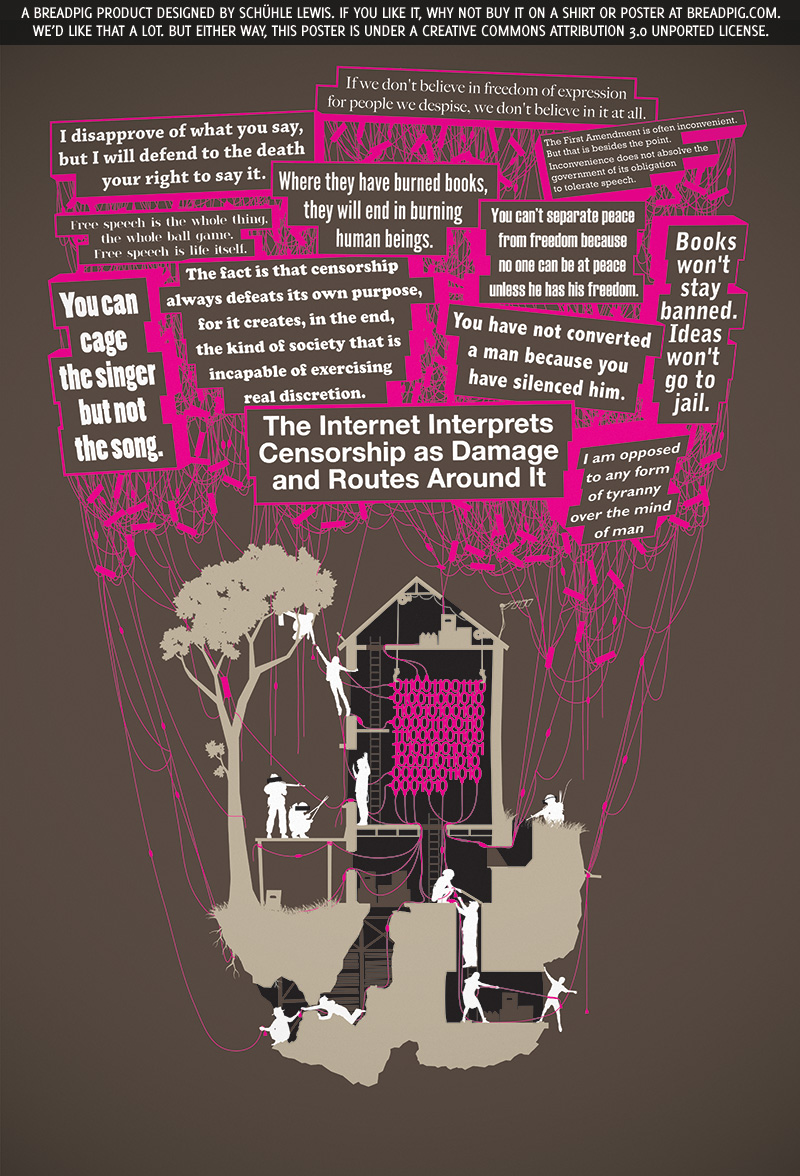
An excellent poster from Schuhle Lewis. Currently hanging in my front hallway.
  • If you like the image above, you can pick it up from the Breadpig Store. 100% of profits go to the Electronic Frontier Foundation, who I would give money to any day of the week. EFF is the leading civil liberties organization defending free speech, privacy, and innovation on the net.
  • The newly updated Derailing For Dummies. One of my favourite redirects for when I'm having a conversation with someone who does Doesn't Get It on issues of privilege. Required reading for social justice conversations on the interwebs, and for commenters on social justice related posts on this blog. Hop to it!
  • And if you're wondering how I can support and organization like the EFF and require that comments this blog maintain a modicum of respect for the full humanity of folks who aren't privileged white men, I give you TigTog's It's not censorship when it's a personal decision over privately owned space. This issue comes up on feminist (and anti-racist, and Marxist, etc etc) blogs a lot. Say it with me now: it's not censorship if it's not being perpetrated by the government. And freedom of speech doesn't equal freedom from criticism. "It's just my opinion" doesn't float with me, folks.

Wednesday, September 8, 2010

Virtual Space and Virtual Place

A lot of early writing about digital environments worked through the idiom of 'cyberspace'. Cyberspace -- a word coined by author of Neuromancer and all-around badass William Gibson -- is one of those slippery words you come across quite often when people talk about digitial technologies and new media. It means a lot of things to a lot of people, but generally, if you hear someone talking about cyberspace, they're talking about the sphere of activity created by communications technologies, specifically activity on the internet. Cyberspace, as a term, has fallen out of vogue, but virtual space comes up with relative frequency, and so is still worth addressing, I think.

Why do we hear so much about virtual space and not about virtual place? It seems to have something to do with the slippage in meaning between place and space. Places are not just bounded portions of space. Rather, they are spaces that are imbued with meaning. What makes a place a place is it's specificity, not only in geography but also in networks of meaning and imagination. Our homes and schools are places only insofar as they carry with them our memories and interactions. Without these associated meanings, they fall into the category of locations. Without names or meaningful structures, they become simply portions of space.

Transferring this distinction to the realm of the virtual, it is easy to understand what we mean by virtual space, and even by virtual location. Virtual space (or spaces) are bounded only by the fact that they exist within the sphere of the virtual. Virtual locations are denoted by URLs and website infrastructures. But what is a virtual place?

One of the easiest ways to think about virtual place is in the context of video games/virtual worlds, like World of Warcraft and Second Life. These environments recreate our experience of place by mimicking the aspects of place that we rely on in the real world -- landscapes, buildings, neighbourhoods, etc, are used to denote this place from that. But if our notion of place in the virtual world is restricted solely to digitally rendered environments, then it is sorely lacking in its ability to adequately describe all aspects of online experience.

A better example of what I mean when I talk about a virtual place over a virtual space is the interlocking places and sites that make up media fandom. Sites like Fandom Wank, Metafandom, and the various archives, LiveJournal communities, personal journals and message boards that see a variety of fannish activities take on the role of places, rather than simply locations. They are places that attract certain types of people, certain modes of conversation, and carry with them particular histories that embed them in networks of meaning that extend through time. But they don't have the traditional markers of place -- all of the geographical, topographical, and architectural touchstones that we use to describe or delineate one place from another. How can we represent virtual place to ourselves and to others, for whom the place may be simply a location, or an unbounded part of cyberspace? How does thinking through the difference between virtual space and virtual place allow us a more nuanced understanding of what online communities and interactions look like?

These questions point towards a need for internet-centered research that focuses on the historically-sensitive nature of virtual communities, and the places they make for themselves. We need a new vocabulary in order to talk about digital infrastructures -- what makes some online spaces more amenable to "place"-ification than others? But we also need a new language to talk about virtual communities. All too often the language of networks dislocates online communities from their spatial and temporal settings. Representations of online communities too often look like this:


These types of images tell us about connections between people, but not abut connections between people and the places they occupy and make meaningful to themselves and their communities. We need to come up with better ways of describing, studying, representing, and building virtual places if we are going to come to a fuller understanding of what virtual communities and relationships look like. We need better ethnographies of the virtual, and better anthropologies of the digital. Over the last decade we've come to understand that the virtual does not transcend or erase the body, despite the predictions of (mostly white, mostly male) digital utopians. But neither does the virtual transcend the historical or the spatial. If we are going to talk about the Internet in a way that makes sense for people who have real relationships and real attachments to online communities, we need to develop a conceptual vocabulary that acknowledges and upholds the placefulness, rather than the spaciousness, of the virtual world.