Showing posts with label nature. Show all posts

Wednesday, January 26, 2011

Genna Kusch's art of the imagination

"I, said the Sparrow, with my bow and arrow..."
Multi-part woodcut, 2009
Over the last few years, I've had the pleasure and the privilege of talking about art and literature--among a host of other things--with Genna Kusch, a Canadian artist currently living and working in Scotland. The first person ever to discuss with me about the politics of curating and displaying art in a museum, and always willing to spend a few hours over drinks talking about CBC radio podcasts, Kusch's work has been inspiring me for years to rethink my attitudes towards children's literature in general, and animal stories in particular. Her art takes up the themes of wildernesses, found both in the mind and the heart as well as right outside our doorsteps. Working primarily in print, Kusch situates her pieces firmly within the tradition of  illustration that recalls the beautiful books we remember from childhood.

Kusch's art draws on the stories and rhymes that make up the children's literature canon in the Western world. Referencing sources as diverse as the nursery rhyme "Who Killed Cock Robin?", the popular French Canadian children's song "Alouette", and the always beloved Peter Pan, her recent work explores the fantasies and dangers of the child's engagement with nature.

In her artist statement, Kusch cites my always-favourite essayist on, and writer of, fantasy literature, Ursula K. LeGuin. In her lengthy piece on animals in children's literature (reproduced in Cheek by Jowl) LeGuin explores our tendency to give books about animals to children:
In postindustrial civilization, where animals are held to be irrelevant to adult concerns, animal story is mostly perceived as being for children...
It appears that we give animal stories to children and encourage them to be interested in animals because we see children as inferior, mentally 'primitive', not yet fully human: so pets and zoos and animal stories are 'natural' steps on the child's way up to adult, exclusive humanity--rungs on the ladder from mindless, helpless babyhood to the full glory of intellectual maturity and mastery. Ontology recapitulating phylogeny in terms of the Great Chain of Being.
But what the is it the kid is after?...What is it that the child perceives that her whole culture denies?
It is this question that Kusch's work takes up. In her twin pieces "Last Night's Child" and "Tonight's Child", she draws out the fantastical fears that compel us both to flee from and linger with stories like Red Riding Hood:

Last Night's Child and Tonight's Child
Lithographs, 2009

In these images the wilderness colonizes the body of the child, but it is unclear what makes this notion horrifying: the prospect that she has become a monster, or the possibility that she has been one all along? This engagement with the dark side of childhood is also evident in her wall-sized multi-part woodcut, At the Playground:
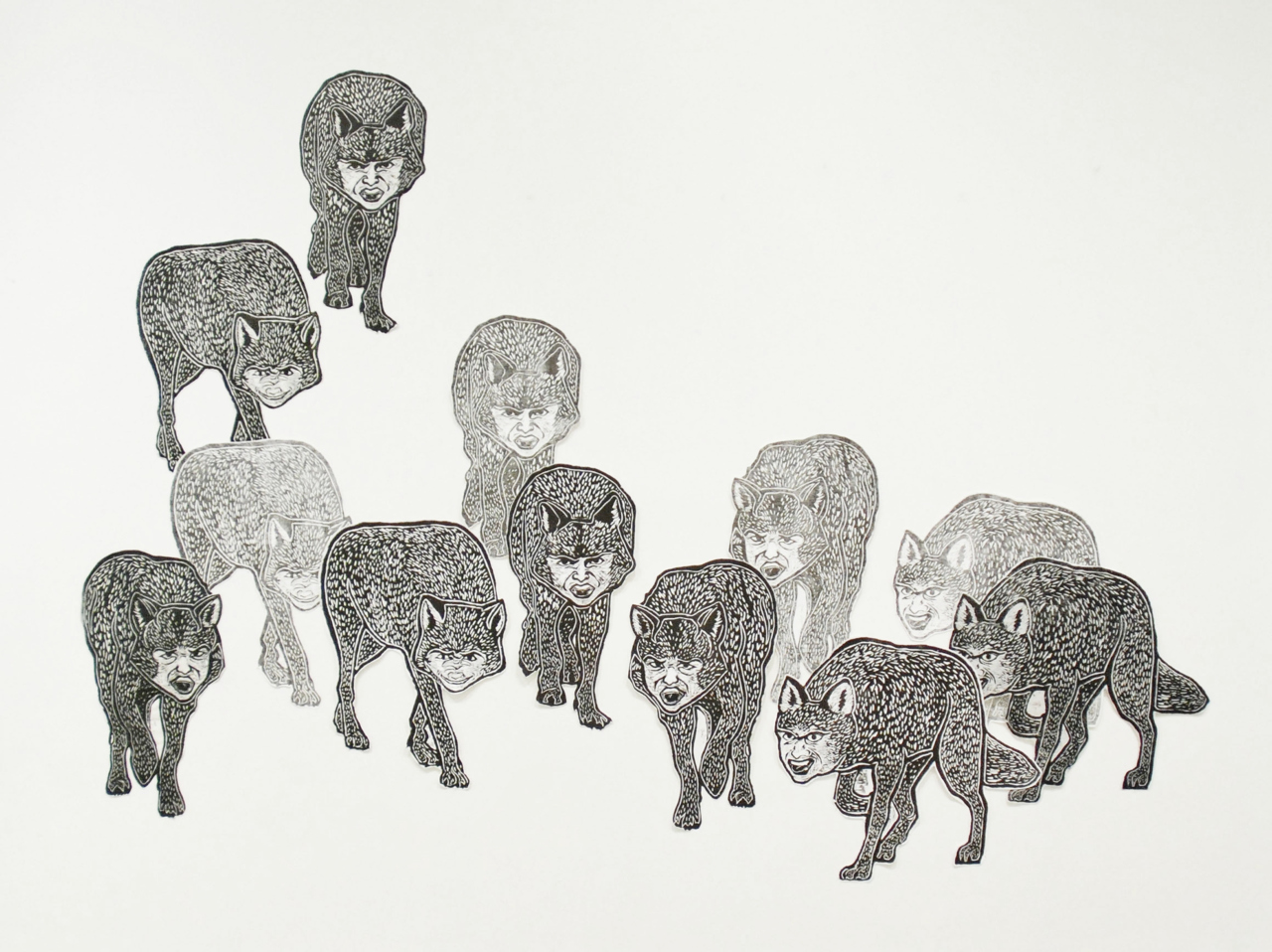

At the Playground
Multi-part woodcut, 2009
Here, the faces of the wolves are replaced by the faces of children, wearing the taunting, mocking expressions that so often form the content of the wilderness of youth. Kusch's artistic response to the question posed by LeGuin--what is it that the child perceives that her whole culture denies?--is that stories about animals are also stories about people; that children can be like wolves stalking the forest, or like girls who shift between child and beast.

The relationship of the idea of wilderness to childhood was brought to the forefront recently in Michael Chabon's essay "The Wilderness of Childhood". Childhood, he argues, "is a branch of cartography":
Childhood is, or has been, or ought to be, the great original adventure, a tale of privation, courage, constant vigilance, danger, and sometimes calamity. For the most part the young adventurer sets forth equipped only with the fragmentary map—marked here there be tygers and mean kid with air rifle—that he or she has been able to construct out of a patchwork of personal misfortune, bedtime reading, and the accumulated local lore of the neighborhood children.
LeGuin also makes use of the mapmaking metaphor in her rebuke of critics who discount the value of fantasy:
The monstrous homogenization of our world has now almost destroyed the map, any map, by making every place on it exactly like every other place, and leaving no blanks. No unknown lands...In reinventing the world of intense, unreproducible, local knowledge, seemingly by a denial or evasion of current reality, fantasists are perhaps trying to assert and explore a larger reality than we now allow ourselves. They are trying to restore the sense...that there is somewhere else, anywhere else, where other people may live another kind of life.
Kusch's work is a part of this cartography of the fantastic, the filling in of the imaginary characters of the very real terrors of children's lives. Not all of her work brandishes this element of horror, but it lurks in the background of even her earlier paintings: insects crawl on translucent hands, bones and masks shroud faces in mystery. Ultimately, though, these woodcuts and etchings offer a semblance of reassurance. Not the shallow comfort of nostalgia or the poorly concealed anxiety of helicopter parenting, but the fortitude that comes from a confrontation with the fact that no matter how we try to quash them, we all have our wildernesses, and we all must face them with the courage of a child at play.

Saturday, January 8, 2011

Erin McSavaney's INLAND exhibit

While tooling around on the internet yesterday, as I am wont to do, I came across these lovely paintings by Canadian artist Erin McSavaney. Part of her INLAND exhibit at Vancouver's Equinox Gallery, the paintings move away from McSavaney's previous engagement with the lost urban spaces of back alleys and loading bays, and toward and exploration of the relationship between nature and rural architecture:

Crows Nest Highway - Nursery, acrylic on canvas, 2010

Trans Canada Highway - Laidlaw, acrylrc on canvas, 2010


Wednesday, December 15, 2010

Andy Goldsworthy's transient art

Every once in a while, especially when I'm in the generally stressed out state that grading puts me in, I like to turn on a documentary on good ol' Netflix. I've been a documentary hound for as long as I've been a non-fiction reader, but the stressed-out documentary choice has one very specific requirement: it can be about anything, as long as it's quiet.

Two nights ago, I found the perfect film for this purpose. Rivers and Tides is a joint Irish-German production about Andy Goldsworthy, a sculptor and environmentalist whose site-specific land art is some of the most beautiful I've ever seen. Working only with natural elements, Goldsworthy creates pieces that explore the ephemerality of nature and time, and often end up consumed by very environments from which he draws his inspiration:


As a sociologist who works primarily in the realm of the digital--and certainly in the realm of the modern--I don't often get the opportunity to think rigorously about nature. About the closest I manage is reading about mediated landscapes, or the social construction of frontiers. I also don't get a lot of time to think about art, although it comes up slightly more often. In spite of--or perhaps because of--this, I found myself riveted for the full two hour exploration of Goldsworthy's art. Early on in the film there is a sequence in which he attempts repeatedly to build one of his famous stone seeds, conical structures build from flat rocks. Three times in a row, the sculpture falls apart, and each time the tide on the beach where he is working comes closer to where he sits. The final product, eventually completed, ends up completely subsumed by the water of the bay, only to be revealed again when the tide recedes. It is both an astonishingly slow process and one in which we are reminded of constant movement of time.

Much of Goldsworthy's work is less permanent; he often works in ice, in leaves, and in sticks, in places not amenable to permanent structures. This type of impermanence in art can often come across as whimsical, but Goldsworthy's commentary throughout the film shows that he is interested in the ephemeral not because it is pretty, but because it is a window into collaboration with nature.


In a week where I've spent the majority of my work time thinking about technology, risk, and retaining a sense of 'place'-fulness in theories of the virtual, and most of my play time reading Rutsky's High Techne and Tichi's Shifting Gears (both about technology and art), Rivers and Tides was a profoundly beautiful reminder that the modern can be natural, and that the ephemeral and the eternal are as present in nature as they are in culture.