Showing posts with label books. Show all posts

Monday, May 9, 2011

The politics and aesthetics of steampunk

In a recent fit of rampant websurfing -- signing up for Twitter has made me infinitely more aware of just how much there is to read out there -- I came across James Bridle's fabulous BookTwo.org blog. As a recent owner of a Kindle (but an eternal lover of the printed page) I've been looking for some interesting thinking about the changing nature of information and materiality. But while there will be more on that subject in future posts, it was a series of posts by Bridle about 'bookfuturism' on HiLobrow that initially caught my eye.

In the second post, Bridle discusses the politics (or lack thereof) in steampunk. Having spent much of March following the conflict that ensued after steampunk magazine Gatehouse Gazette published its "Victorientalism" issue -- and yes, that is exactly as bad as it sounds -- the relationship between the the aesthetics of nostalgia and the politics of social history has been on my mind. From N. Ottens' "In Defense of Victorientalism":

[Issue #11 of the Gatehouse Gazette was written] to redeem, if only for a moment, if only in the space between our computer screens and our imagination, the inaccurate, the imperfect and the improper but the oh so romantic and beguiling fantasy that was Asia before we actually knew it. 
Is this disdainful and snobbish and patronizing? Perhaps. But then, isn’t all of steampunk? We blissfully reminiscence about imperial grandeur, shuffling aside the slavery, the segregation, the tyranny and the bloodshed there were also part of it. We are only too willing to recreate, in our writings and in our costuming, the tastes and sensibilities of the Victorian upper class, ignoring, very often, the misery of the poor and the desolation of the oppressed. Is it obnoxious? Probably. Is it offensive? No. Because steampunk is fiction, not research. 
As much as the average steampunk enthusiast doesn’t pretend to fully nor faithfully reconstruct the past, Victorientalism makes no claim at objective study of Asian cultures. Ay-leen believes that there would be no problem, “if the political and social effects of Orientalism were dead and gone,” but should we feel embarrassed for telling certain stories and enjoying a distorted nostalgia because there are still plenty of xenophobic imbeciles out there who might think we’re serious? Surely not!
This argument -- that reveling in the aesthetics of an era does not mean embracing the unsavory politics of that very same -- doesn't hold water. The forcible severing of politics and aesthetics in the essay leaves much to be desired; we know from Said's Orientalism (at the very least) that this particular Gordian knot is not an easy one to cut. The enjoyment of this 'distorted nostalgia' for a vision of the world that did not only appear in books and stories, but was also actively used to marginalized and oppress should be something that gives us pause.

On the other side of the discussion, is sci-fi author Charles Stross' objection to the recent influx of steampunk into the SFF sections of bookstores nationwide. His essay, 'The Hard Edge of Empire' starts out with the somewhat off-putting claim that there's too much steampunk these days, but quickly abandons that tack for the more compelling argument that the aesthetics of early industrial modernity in fiction often overlook their genesis in an era that was not particularly pleasant for the majority of its inhabitants. After spending the weekend reading George Orwell's harrowing The Road to Wigan Pier and Rebecca Harding Davis' Life in the Iron Mills, I'm inclined to agree. From Stross' essay:
You probably think I'm going a little too far in my blanket condemnation of a sandbox where the cool kids are having altogether too much fun. But consider this: what would a steampunk novel that took the taproot history of the period seriously look like? 
Forget wealthy aristocrats sipping tea in sophisticated London parlours; forget airship smugglers in the weird wild west. A revisionist mundane SF steampunk epic — mundane SF is the socialist realist movement within our tired post-revolutionary genre — would reflect the travails of the colonial peasants forced to labour under the guns of the white Europeans' Zeppelins, in a tropical paradise where severed human hands are currency and even suicide doesn't bring release from bondage... It would share the empty-stomached anguish of a young prostitute on the streets of a northern town during a recession, unwanted children (contraception is a crime) offloaded on a baby farm with a guaranteed 90% mortality rate through neglect. The casual boiled-beef brutality of the soldiers who take the King's shilling to break the heads of union members organizing for a 60 hour work week. The fading eyesight and mangled fingers of nine year olds forced to labour on steam-powered looms, weaving cloth for the rich. 
The question here is not whether or not we should be writing science fiction that has steam-powered computers in a Dickensian other-London, but whether or not our fiction should have to deal with the socio-economic ramifications of the industrialism from whence the draws its taste for clockwork and brass. The best steampunk stories at least tangentially touch on the question of where the resources that produce the steam come from.

This valorization and aestheticization of nostalgia doesn't exist solely in the realm of genre fiction. Television, film, fashion, and music have all gone gaga for times past in recent years. But genre fiction, which so often holds up a mirror to contemporary society and demands that we take a good hard look at the way things are, has an unique opportunity in steampunk. Situated within a literary tradition where world-building is often (almost) as important as character development and plot, steampunk writers -- and the retrofuturists who poach from them -- have the chance to perform an autopsy on the socio-political birth of technological modernity. Moreover, they have the opportunity to re-envision industrialism in such a way as to make evident the ways in which the 'oh so romantic and beguiling' fantasies of Victorian imperialism, class hierarchy, and colonialism are deeply and directly implicated in our contemporary moral and social imaginations. To engage uncritically with the legacy of this era, and instead reduce it to an apolitical aesthetic to be spray-painted on science fiction at will is not only missing an opportunity to use science fiction to its full critical potential -- it also continues a narrative in which the erasure of the labouring bodies behind technological advancements is par for the course, both in genre fiction and outside of it.

Wednesday, May 4, 2011

Quick Hits: Getting back in the blogging game edition

  • A great video from the Guttmacher Institute on the facts about abortion in the United States. That abortion is primary health care for women should be uncontested -- that it remains contested is often the result of the spread of misinformation over facts, which is why interventions like this are so valuable:

  • A great little piece in the New York Times about the history of book branding. I'm a geek for little facts about things I love -- hearing that Walt Whitman wrote his own glowing, anonymous reviews warms the cockles of my bibliophile heart.
  • Michael Chabon is writing the introduction to Knopf's 50th anniversary edition of The Phantom Tollbooth. When I was a kid, my dad used to read out loud to me and my brother in the evenings; Norton Juster's whip-smart children's classic was one of our all time favourites. Chabon's introduction is excerpted in the New York Review of Books, and well worth the read.
  • Ta-Nehisi Coates has become a mainstay of my RSS feed (if the NYT is looking for someone to replace Bob Herbert, I think he'd be an excellent choice. Here he argues that the American Civil War wasn't tragic -- at least, not in the way it is often portrayed.
  • Margaret Atwood on tweeting: "So what’s it all about, this Twitter? Is it signaling, like telegraphs? Is it Zen poetry? Is it jokes scribbled on the washroom wall? Is it John Hearts Mary carved on a tree? Let’s just say it’s communication, and communication is something human beings like to do". Speaking of which, Textual Relations is now on Twitter! I don't think I've quite got the hang of this tweeting thing yet, but practice makes perfect, right?
  • I'm not usually one for network analysis, but Kieran Healy, writing for Crooked Timber, points out an article in the New Left Review that uses network methods to look at classic literature. That's something I can definitely get behind.
  • Critical interventions in Ursula K. LeGuin, including a great short essay by LeGuin herself on American SF and the Other: "I think it's time SF writers—and their readers!—stopped daydreaming about a return to the Age of Queen Victoria, and started thinking about the future. I would like to see the Baboon Ideal replaced by a little human idealism, and some serious consideration of such deeply radical, futuristic concepts as Liberty, Equality, and Fraternity. And remember that about 53% of the Brotherhood of Man is the Sisterhood of Woman."

In the past two weeks I've: finished my grading, submitted my grades, finished a paper, said goodbye to my lovely American friends, and moved to Halifax for the summer. In light of all of that, my blogging brain needs to be rekindled a little. So I'm taking suggestions -- what would you like to see me blog about?

Monday, April 11, 2011

On books and reading

Today I came across two different (or maybe the same) ideas about reading, by two very different authors coming from two very different places. The first is from Italo Calvino, and it reminds me of every trip I've ever made to a used bookstore:
In the shop window you have promptly identified the cover with the title you were looking for. Following this visual trail, you have forced your way through the shop past the thick barricade of Books You Haven't Read, which were frowning at you from the tables and shelves, trying to cow you. But you know you must never allow yourself to be awed, that among them there extend for acres and acres the Books You Needn't Read, the Books Made For Purposes Other Than Reading, Books Read Even Before You Open Them Since They Belong To The Category Of Books Read Before Being Written. And thus you pass the outer girdle of ramparts, but then you are attacked by the infantry of the Books That If You Had More Than One Life You Would Certainly Also Read But Unfortunately Your Days Are Numbered. With a rapid maneuver you bypass them and move into the phalanxes of the Books You Mean To Read But There Are Others You Must Read First, the Books Too Expensive Now And You'll Wait Till They're Remaindered, the Books ditto When They Come Out In Paperback, Books You Can Borrow From Somebody, Books That Everybody's Read So It's As If You Had Read Them, Too. Eluding these assaults, you come up beneath the towers of the fortress, where other troops are holding out: 
the Books You've Been Planning Top Read For Ages,
the Books You've Been Hunting For Years Without Success,
the Books Dealing With Something You're Working On At The Moment,
the Books You Want To Own So They'll Be Handy Just In Case,
the Books You Could Put Aside Maybe To Read This Summer,
the Books You Need To Go With Other Books On Your Shelves,
the Books That Fill You With Sudden, Inexplicable Curiosity, Not Easily Justified,

Now you have been able to reduce the countless embattled troops to an array that is, to be sure, very large but still calculable in a finite number; but this relative relief is then undermined by the ambush of the Books Read Long Ago Which It's Now Time To Reread and the Books You've Always Pretended To Have Read And Now It's Time To Sit Down And Really Read Them.
Dawn Treader Bookshop, one of my favourite bookstores in the world.
 The second is from Nick Hornby, from his preface to Housekeeping vs. The Dirt, and informs all of my book choices that aren't directly necessary for school-related reading:
But what's proper? Whose books will make us more intelligent? Not mine, that's for sure. But has Ian McEwan got the right stuff? Julian Barnes? Jane Austen, Zadie Smith, E. M. Forster? Hardy or Dickens? Those Dickens readers who famously waited on the dockside in New York for news of Little Nell -- were they hoping to be educated? Dickens is Literary now, of course, because the books are old. But his work has survived not because he makes you think, but because he makes you feel, and he makes you laugh, and you need to know what is going to happen to his characters...How much cleverer will we be if we read Of Mice and Men, Steinbeck's beautiful, simple novella? Or Tobias Wolff's brilliant This Boy's Life, or Lucky Jim, or To Kill a Mockingbird. Enormous intelligence has gone into the creation of all of theses books, just as it has into the creation of the iPod, but the intelligence is not transferable. It's there to serve a purpose.
But there it is. It's set in stone, apparently: books must be hard work; otherwise they're a waste of time. And so we grind out war through serious, and sometimes seriously dull, novels, or enormous biographies of political figures, and every time we do so, books come to seem a little more like a duty, and Pop Idol starts to look a little more attractive. Please, please, put it down.
...reading for enjoyment is what we should all be doing. I don't mean we should all be reading chick lit or thrillers (although if that's what you want to read, it's find by me, because here's something else no one will ever tell you: if you don't read the classics, or the novel that won this year's Booker Prize, then nothing bad will happen to you; more importantly, nothing good will happen to you if you do); I simply mean that turning pages should not be like walking through thick mud. The whole purpose of books is that we read them, and if you find you can't, it might not be your inadequacy to blame. 
And, finally, in the words of Cory Doctorow:
We are the people of the book. We love our books. We fill our houses with books. We treasure books we inherit from our parents, and we cherish the idea of passing those books on to our children...We know our tribespeople when we visit their homes because every wall is lined with books. There are teetering piles of books beside the bed and on the floor; there are masses of swollen paperbacks in the bathroom. Our books are us. They are our outboard memory banks and they contain the moral, intellectual, and imaginative influences that make us the people we are today.
Some days other people's words are better than my own. Today was one of those days.

Friday, April 8, 2011

Cultural histories of the computer: The Closed World, From Counterculture to Cyberculture, and The Net Effect

The Closed World: Computers and the Politics of Discourse in Cold War America by Paul Edwards
From Counterculture to Cyberculture: Stewart Brand, the Whole Earth Network, and the Rise of Digital Utopianism by Fred Turner
The Net Effect: Romanticism, Capitalism, and the Internet by Thomas Streeter

One of my intellectual bugaboos is the frequency with which books about the internet are written without regard to the history of the computer as a cultural artifact. Reading about about online communication without knowing about what computers have represented throughout the past century feels like jumping into a movie during the last ten minutes -- exciting things might be happening, but it's really difficult to piece out exact what's going on. Fortunately, there are three books out there that, when read in tandem, provide a fairly comprehensive overview of the major threads that make up the cultural history of computing in the United States.

The first is Paul Edwards' engaging and influential (both Turner and Streeter cite Edwards in their own books) The Closed World. Eschewing the traditional methods of the history of technology, Edwards' work emphasizes the ways in which computers functioned as both cultural metaphors and political icons. Moving beyond the question of what computers have actually accomplished as devices -- questions well-covered in other books -- he instead focuses on the influence of the rise of computing on our understanding of human subjectivity, in the context of the American political imagination during the Cold War.

Divided into two parts, Edwards takes up the notion that computers as metaphors, as well as artifacts, to draw together two apparently unconnected histories: that of military computing during the Cold War (his exploration of the SAGE computerized air defense system is particularly compelling), and that of cognitive psychology and artificial intelligence. Making use of the notions of cyborg discourse and closed-wold discourses, he argues that:
...just as political theory has played a crucial part in constructing political subjects, cognitive theories and computing machines assisted in constructing the subjects who inhabited the electronic battlefields of global cold war. Interpreting human minds as information processing machines, cyborg discourse created subject positions within a political world enclosed by computer simulation and control...It collaborated in the creation of powerful closed world metaphors, analyzing the mind as a closed control system subject to technical manipulation.
This language of the closed world and technical control and manipulation provides the central topic of The Closed World. Here we have a vision of the development of computing technology and computational metaphors directed toward the command-and-control mentality of Cold War America. The sensation described by the members of the Berkeley Free Speech movement -- one of the transformation of the self into data on an IBM card -- was, in part, a reaction to this vision of closed world ideology of computing.

It is here where Fred Turner's From Counterculture to Cyberculture picks up the narrative. Rather than focusing on the large-scale computing done by the military-industrial complex, Turner turns his gaze on Stewart Brand and the first wave of digital utopians -- those individuals who looked at computers and saw not only opportunities for more precise control, but also expansive possibilities for a more democratic society.

Turner’s book provides a narrative that winds from Sproul Plaza at a radicalized 1968 Berkeley through Silicon Valley in the networked nineties, stopping briefly to examine a host of socio-cultural events that provide the backdrop to the emergence of the Information Age. Exploring the evolution of the computer as a metaphor simultaneously with the emergence of information networks both on- and offline, Turner provides a meticulous account of the way computers and culture work to co-constitute one another. Furthermore, From Counterculture to Cyberculture contributes a unique and, up to this point, unparalleled, history of digital utopianism as a cultural philosophy. While there are many books available -- Nicholas Negroponte's Being Digital is probably the flagship work of the particular genre -- that provide excellent examples of what digital utopianism looks like (in both its positive and negative forms), Turner’s is one of the first to actually take this movement seriously as a historical subject.

Drawing a line from Ken Kesey's Merry Pranksters to the rise of the personal computer is a daunting task, but one Turner manages with aplomb. Working against Cold War visions of massive computers doing command-and-control work, countercultural technologists re-imagined computers as tools for personal liberation, locations for virtual alternative communities, and the site of exploration of both social and technological frontiers. That this movement culminated in the founding of Wired magazine is no surprise.

In the end, Turner writes:
Thanks in no small part to Brand's work at the Whole Earth Catalog and later at Rolling Stone, desktop computers had come to be seen as 'personal' technology. In keeping with the New Communalist ethos of tool use, they promised to transform individual consciousness and society at large. Thanks to the citizens of the WELL, computer-mediated communication had been reimagined in terms of disembodied, communal harmony and renamed virtual community. Cyberspace itself had been reconfigured as an electronic frontier.
 But Turner goes on:
Even as they decoupled computers from their dark, early 1960s association with bureaucracy, then, Brand and the Whole Earth community turned them into emblems not only of New Communalist social ideals, but of a networked mode of technocratic organization that continues to spread today. In that way, they helped transform both the cultural meanings of information and information technology and the nature of technocracy itself.
So where, ultimately, do these counter-narratives of the emergence of computers and computational metaphors leave us? This is where Thomas Streeter's The Net Effect begins. Published just this past December, Streeter's work carries the cultural history of computers into the Internet age. Where The Closed World ends with only a general nod toward the Internet, and From Counterculture to Cyberculture devotes a chapter to 'the triumph of the network mode', The Net Effect takes up the Internet as its primary subject of analysis.

Streeter embeds his discussion of the cultural history of the Internet squarely between the closed world logic embraced by Edwards' military-industrial complex and the new communalist utopianism engaged in by Turner's techno-hippies. The Internet, he argues, is best understood as a negotiation between our cultural tendency to romanticize 21st century technologies, and the requirements of neoliberalism in a global economy. Here is a story in which neither the virtual world is neither a virtual paradise nor an electronic battleground -- it is instead a social site, like many others, where individuals and communities struggle over meaning when confronted with situations previously unimaginable.

The time spent by Streeter on the development of cyberlaw and the open source movement are particularly enlightening. With the advent of the microchip -- previous to the widespread use of the internet -- capitalism enters the narrative for the first time. By the time the internet is a household name, neoliberal ideology had crept into the digital utopianism of the Steward Brand era. Open source programmers, hackers, moving away from the countercultural ethos of the new left, embraced a romantic individualism that could just as easily work in service of capitalist economic projects as against them. But Streeter's book is not a polemic against the integration of the market and the net. Rather, it is a skillful exploration of the ways in which the narrative threads picked up by Edwards and Turner have been entangled in recent decades. Taken on it's own, The Net Effect is an interesting book about American cultural ideologies of romantic individualism, applied to the net. Taken as a contribution to a historical-theoretical tradition that begins with The Closed World, however, and Streeter's work becomes an important piece of the cultural history of computing puzzle.

For anyone with the time and the inclination to think about what computers mean for culture (and what culture means for computers) in contemporary American life, I highly recommend adding these three books to your summer reading list. If you're a geek for cultural studies, technological history, and, of course, computers, you won't regret it.

Sunday, March 6, 2011

The Most Photographed Barn in America

Corinne Vionnet's St Basil's Cathedral, Moscow; part of Photo Opportunities, a series of images by layering 200-300 tourist of the same landmarks on top of one another.
     Several days later Murray asked me about a tourist attraction known as the most photographed barn in America. We drove twenty-two miles into the country around Farmington. There were meadows and apple orchards. White fences trailed through the rolling fields. Soon the signs started appearing. THE MOST PHOTOGRAPHED BARN IN AMERICA. We counted five signs before we reached the site. There were forty cars and a tour bus in the makeshift lot. We walked along a cowpath to the elevated spot set aside for viewing and photographing. All the people had cameras; some had tripods, telephoto lenses, filter kits. A man in a booth sold postcards and slides--pictures of the barn taken from the elevated spot. We stood near a grove of trees and watched the photographers. Murray maintained a prolonged silence, occasionally scrawling some noes in a little book. 
     "No one sees the barn," he said finally.
     A long silence followed.
     "Once you've seen the signs about the barn, it becomes impossible to see the barn."
     He fell silent once more. People with cameras left the elevated side, replaced at once by others.
     "We're not here to capture an image, we're here to maintain one. Every photograph reinforces the aura. Can you feel it, Jack? An accumulation of nameless energies."
     There was an extended silence. The man in the booth sold postcards and slides.
     "Being here is a kind of spiritual surrender. We see only what the others see. The thousands who were in the past, those who will come in the future. We've agreed to be a part of a collective perception. This literally colors our vision. A religious experience in a way, like all tourism."
     Another silence ensued.
     "They are taking pictures of taking pictures," he said.
     He did not speak for a while. We listened to the incessant clicking of shutter release buttons, the rustling crank of levers the advanced the film.
     "What was the barn like before it was photographed?" he said. "What did it look like, how was it different from other barns, how was it similar to other barns? We can't answer these questions because we've read the signs, seen the people snapping the pictures. We can't get outside the aura. We're part of the aura. We're here, we're now."
     He seemed immensely pleased by this. 
          -- Don DeLillo, White Noise


I've been away from the blog for the last week or so -- reading week in sunny (har har) Halifax has had me reading Mark Danielewski's House of Leaves, marathoning on the third season of Deadwood and drinking copious amounts of Propellor beer. Should be back to my regular (if it can be called that) posting schedule later in the week; upcoming subjects include the byline gender gap, popular press books that take a dystopic view of the effect of the Internet on the human mind, and what it's like to watch The Godfather a million years after everyone else has seen it. Because I just did that. At the age of twenty-four.

Wednesday, January 26, 2011

Genna Kusch's art of the imagination

"I, said the Sparrow, with my bow and arrow..."
Multi-part woodcut, 2009
Over the last few years, I've had the pleasure and the privilege of talking about art and literature--among a host of other things--with Genna Kusch, a Canadian artist currently living and working in Scotland. The first person ever to discuss with me about the politics of curating and displaying art in a museum, and always willing to spend a few hours over drinks talking about CBC radio podcasts, Kusch's work has been inspiring me for years to rethink my attitudes towards children's literature in general, and animal stories in particular. Her art takes up the themes of wildernesses, found both in the mind and the heart as well as right outside our doorsteps. Working primarily in print, Kusch situates her pieces firmly within the tradition of  illustration that recalls the beautiful books we remember from childhood.

Kusch's art draws on the stories and rhymes that make up the children's literature canon in the Western world. Referencing sources as diverse as the nursery rhyme "Who Killed Cock Robin?", the popular French Canadian children's song "Alouette", and the always beloved Peter Pan, her recent work explores the fantasies and dangers of the child's engagement with nature.

In her artist statement, Kusch cites my always-favourite essayist on, and writer of, fantasy literature, Ursula K. LeGuin. In her lengthy piece on animals in children's literature (reproduced in Cheek by Jowl) LeGuin explores our tendency to give books about animals to children:
In postindustrial civilization, where animals are held to be irrelevant to adult concerns, animal story is mostly perceived as being for children...
It appears that we give animal stories to children and encourage them to be interested in animals because we see children as inferior, mentally 'primitive', not yet fully human: so pets and zoos and animal stories are 'natural' steps on the child's way up to adult, exclusive humanity--rungs on the ladder from mindless, helpless babyhood to the full glory of intellectual maturity and mastery. Ontology recapitulating phylogeny in terms of the Great Chain of Being.
But what the is it the kid is after?...What is it that the child perceives that her whole culture denies?
It is this question that Kusch's work takes up. In her twin pieces "Last Night's Child" and "Tonight's Child", she draws out the fantastical fears that compel us both to flee from and linger with stories like Red Riding Hood:

Last Night's Child and Tonight's Child
Lithographs, 2009

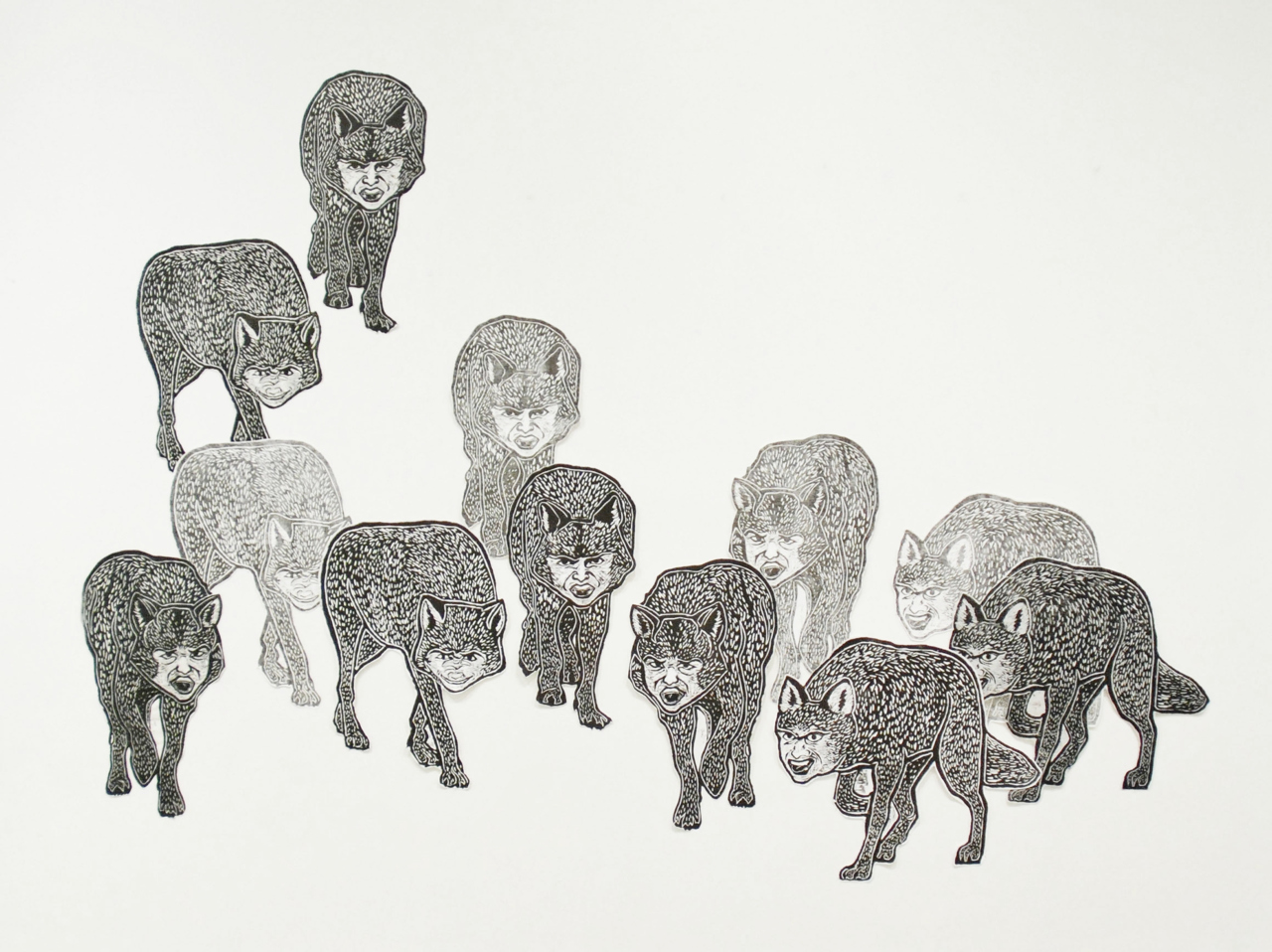
In these images the wilderness colonizes the body of the child, but it is unclear what makes this notion horrifying: the prospect that she has become a monster, or the possibility that she has been one all along? This engagement with the dark side of childhood is also evident in her wall-sized multi-part woodcut, At the Playground:


At the Playground
Multi-part woodcut, 2009
Here, the faces of the wolves are replaced by the faces of children, wearing the taunting, mocking expressions that so often form the content of the wilderness of youth. Kusch's artistic response to the question posed by LeGuin--what is it that the child perceives that her whole culture denies?--is that stories about animals are also stories about people; that children can be like wolves stalking the forest, or like girls who shift between child and beast.

The relationship of the idea of wilderness to childhood was brought to the forefront recently in Michael Chabon's essay "The Wilderness of Childhood". Childhood, he argues, "is a branch of cartography":
Childhood is, or has been, or ought to be, the great original adventure, a tale of privation, courage, constant vigilance, danger, and sometimes calamity. For the most part the young adventurer sets forth equipped only with the fragmentary map—marked here there be tygers and mean kid with air rifle—that he or she has been able to construct out of a patchwork of personal misfortune, bedtime reading, and the accumulated local lore of the neighborhood children.
LeGuin also makes use of the mapmaking metaphor in her rebuke of critics who discount the value of fantasy:
The monstrous homogenization of our world has now almost destroyed the map, any map, by making every place on it exactly like every other place, and leaving no blanks. No unknown lands...In reinventing the world of intense, unreproducible, local knowledge, seemingly by a denial or evasion of current reality, fantasists are perhaps trying to assert and explore a larger reality than we now allow ourselves. They are trying to restore the sense...that there is somewhere else, anywhere else, where other people may live another kind of life.
Kusch's work is a part of this cartography of the fantastic, the filling in of the imaginary characters of the very real terrors of children's lives. Not all of her work brandishes this element of horror, but it lurks in the background of even her earlier paintings: insects crawl on translucent hands, bones and masks shroud faces in mystery. Ultimately, though, these woodcuts and etchings offer a semblance of reassurance. Not the shallow comfort of nostalgia or the poorly concealed anxiety of helicopter parenting, but the fortitude that comes from a confrontation with the fact that no matter how we try to quash them, we all have our wildernesses, and we all must face them with the courage of a child at play.

Sunday, January 16, 2011

Atonement and the art of sound design

I'm approximately four years late on this one -- Atonement was honored in 2007 with an Oscar for Best Original score -- but, having watched the movie again recently, I feel compelled to revisit the film with particular attention to sound design. I'm not usually one to spend a lot of time on the technical details of filmmaking; commentary on cinematography is about the limit of my critical capacities. But Atonement was a film that I came out of wanting to grab people by the shoulders and earnestly discuss the soundtrack and sound editing in the hallway of the theatre (I'm under the impression that many people felt the same way about this year's well-recieved The Social Network). So, at risk of revealing the limits of my knowledge of cinema, here goes nothing.

Atonement, director Joe Wright's adaptation of Ian McEwan's 2001 novel of the same name, is, on the surface, a WWII British love story. Briony, an adolescent upper-middle-class girl in the interwar period makes a terrible error in judgement when she accuses her older sister Cecilia's lover (and the household gardener), Robbie, of rape. The consequences of her actions play out over the course of the film, with devastating results for all involved.

But while Atonement works -- quite well, I might add -- as an interwar, class-inflected tragedy, the film's true power is as a metafiction about the power (and impotence) of narrative. The film, like the novel, unfolds in four parts: a tense and lengthy prologue that culminates in the original lie being told; a melancholic intermission that follows Robbie's years at war in France; a third act that details Briony's work in a Red Cross hospital; and an unexpected epilogue that centers on an elderly Briony, now a successful author, discussing her most recent work. It was this epilogue that many viewers found frustrating, as Briony's novel is the story of her sister and Robbie, rewritten to give them the happy ending that they never had (but that the filmgoer had already experienced as the true outcome of their affair). The metafictional aspect of McEwan's novel, as well as Wright's film, is contained within bounds of the title and the epilogue -- Atonement, both the novel and the film, is fundamentally Briony's story, the writing of which is her atonement for her terrible mistake. By remaking the end, Briony attempts to give her Cecilia and Robbie the happiness her actions denied them in life; it is up to the reader, or the viewer, to decide whether or not the power of narrative extends so far into the realm of morality.

So what does all of this have to do with sound design? The first sounds we hear in Atonement are winding and slow taps of a typewriter. Tick tick tick, and the title card appears on a black screen.


The rhythm of the typewriter recurs throughout the entire first act of the film, sometimes buried underneath emphatic and swirling strings and piano, but always the only percussion apparent in the soundtrack. Moreover, the sounds of the typewriter move between the non-diegetic and diegetic modes, flowing easily from the soundtrack to the sound of the typewriter in Briony's bedroom. Every scene where Briony's perspective overwhelms the narrative, the typewriter arrives, either in the soundtrack or in the film itself. It disappears for the length of the second intermission, but re-emerges when the film centers itself once again on Briony, who works on her novel in the middle of the night.

The shift between diegetic and non-diegetic sound is also evident in the most celebrated scene of the film, the lengthy tracking shot of the army at Dunkirk. Here the soundtrack opens up to make space for the singing of a choir of the wounded as the camera pans across them; as it moves on, their voices fade again into the background.


By the time the epilogue rolls around, the viewer is caught up in Cecilia and Robbie's romance. Do they meet again? How and when? Do they live happily ever after? We are convinced that they must; the lovers must have had more than a few stolen moments in a library all those years ago. And the film rewards this interpretation, at first, allowing us a fleeting glimpse of Cecilia caught up in Robbie's arms on the beach. But the elderly Briony puts all of this to the flames with her revelation that this was the ending she invented for her sister; the real Cecilia died in a subway tunnel during the Blitz, and Robbie died of a fever in France. The frustration for the viewer is palpable, but this isn't a case of the rug being pulled out from under us. While McEwan's novel works clearly as metafiction -- a novel about The Novel -- Wright's film requires an alternative mode to tie together the epilogue with the first three acts of the film. While a portion of this is accomplished through expert editing in the last minutes of the film, the vast majority of it is an achievement of sound design. The film is bookended with the sounds of Briony's story; the early and endless clacking of the typewriter, and the late and endless weaving of her narrative of atonement. 

Friday, January 14, 2011

Ambiguous Utopias: the Science Fiction of Ursula K. LeGuin

As a long time fan of Ursula K. LeGuin, I am almost embarrassed to admit that it's taken me this long to read The Dispossessed, one of her most lauded novels (both in science fiction circles and outside of them).

Winner of the 1974 Nebula Award, as well as the 1975 Hugo and Locus awards, The Dispossessed is at once a sci-fi exploration of alien social worlds, and a philosophical exploration of our own. The novel is set on two neighbouring planets: Anarres and Urras. The inhabitants of these planets were once one people, but in order to prevent an anarcho-syndicalist worker's rebellion, the states of Urras grant the revolutionaries the right to settle on the barren, harsh moon of Anarres, with a promise of non-interference; all of this occurs approximately 200 years before the events of the novel. Anarres maintains an anarchist system of social organization, while Urras is more familiar--state governments, from capitalist-patriarchal to authoritarian-socialist vie with one another for global dominance.

We enter the dual worlds alongside the protagonist, Shevek, a Anarresti physicist who is making the first ever trip by a citizen of Anarres back to Urras. The novel's structure mirrors Shevek's disorientation; every even numbered chapter takes place on Anarres, detailing Shevek's past, while each odd numbered chapter follows his experiences on Urras. This device manages to maintain suspense in two timelines at once--why does Shevek leave Anarres? And does he ever come back?

As in many of her genre books, LeGuin's taught writing and well-rounded characters keep the novel moving, but it is the setting that takes centre stage. The subtitle of the The Dispossessed is "an ambiguous utopia", and this is a telling signifier. The world of Anarres--which could easily be a vicious caricature of anarchist ideas or an uncritical and unrealistic utopia--is, in LeGuin's capable hands, a fully developed social world. Its populace is not unrecognizable; there is vice and avarice, as well as love and altruism. Its materiality is harsh and unforgiving; Anarres is consistently described as a bleak desert landscape, bereft of plants and animals, as well as of magnificent architecture and labour-saving technology. But the characters are warm and believable, and their personalities clearly structured by their membership in a world where ownership is unknown and the worst thing you can be is an "egoist" or a "propertarian".

LeGuin has often been critiqued on for this detail-oriented focus on world building. For science fiction novels, her works display a surprising lack of space battles, hi-tech weaponry, and even significant action sequences of any kind. Despite this, they remain compelling. My interest in LeGuin's work is less about the characters or the plot, and more about her complex--sometimes dauntingly so--explorations of social worlds that, despite being set on alien planets, so closely mirror our own.

The daughter of a prominent anthropologist (Alfred L Kroeber, founder of the Department of Anthropology at Berkeley), LeGuin has noted in multiple places that her fiction has been deeply influenced by anthropological and social thought, as well as her encounters with her father's subjects of study. The Dispossessed is not the only novel of LeGuin's that deserves to be labelled an ambiguous utopia. Her most well-regarded work, The Left Hand of Darkness, describes a planet on which where is no gender. The Telling is set on a world where nature has been subsumed by technology, and The Word for World is Forest is a novella about the clash between a logging colony and the indigenous inhabitants of the planet they share (sci-fi critic Gary Westfahl, in his excellent review of James Cameron's Avatar said that the film most closely resembled LeGuin's novella, out of all its possible predecessors). Perhaps the most beautiful, and disturbing, is LeGuin's short story "The Ones Who Walk Away from Omelas"; which is absolutely worth the twenty minutes it takes to read it online.

What all of these works have in common, and what makes LeGuin's writing so endlessly compelling to me, is that they all share a common commitment to exploring anthropological and sociological ideas. In her essay "A War Without End", LeGuin writes:
In the sense that it offers a glimpse of some imagined alternative to 'the way we live now', much of my fiction can be called utopian, but I continue to resist the word. Many of my invented societies strike me as an improvement in one way or another on our own, but I find Utopia far too grand and too rigid a name for them. Utopia, and Dystopia, are intellectual places. I write from passion and playfulness. My stories are neither dire warning nor blueprints for what we ought to do...To me the important thing is not to offer any specific hope of betterment but, by offering an imagined but persuasive alternative reality, to dislodge my mind, and so the reader's mind, from the lazy timorous habit of thinking that the way we live now is the only way people can live. It is that inertia that allows the institutions of injustice to continue unquestioned.
 By displacing these alternative societies to alien planets, LeGuin allows the reader to accept these ideas as she presents them; a story similar to the one told in The Dispossessed could not be set in the present day, nor the recent past, and maintain its effect. Always nuanced and rarely didactic, The Dispossessed presents the anarchism of Anarres as a real political possibility--with all the flaws and vagaries that come with human social life--in a way that a novel set on Earth never could. Divested from the baggage of the Cold War, and yet subtly pointing towards the politics of that era, The Dispossessed explicitly recognizes the ambiguity of the characters utopias. In a passage toward the end of the novel, Shevek discusses his time on Urras with an ambassador from a future Earth:
"There is no way to act rightly, with a clear heart, on Urras. There is nothing you can do that profit does not enter into, and fear of loss, and the wish for power. You cannot say good morning without knowing which of you is 'superior' to the other, or trying to prove it...There is no freedom. It is a box--Urras is box, a package, with all the beautiful wrapping of blue sky and meadows and forests and great cities. And you open the box, and what is inside it? A black cellar full of dust, and a dead man. A man whose hand was shot off because he held it out to others. I have been in Hell at last. Desar was right; it is Urras; Hell is Urras."
For all his passion he spoke simply, with a kind of humility, and again the Ambassador from Terra watched him with a guarded yet sympathetic wonder, as if she had no idea how to take that simplicity.
 "We are both aliens here, Shevek," she said at last. "I am from much farther away in space and time. Yet I begin to think that I am much less alien to Urras than you are... Let me tell you how this world seems to me. To me, and to all my fellow Terrans who have seen the planet, Urras is the kindliest, most various, most beautiful of all the inhavited worlds. It is the world that comes as close as any could to Paradise."
The structure of the novel facilitates this ambiguity, with the final chapters detailing Shevek's escape from capitalist Urras, as well as his decision to leave anarcho-syndicalist Anarres in the first place. All the while, it is clear that while the material relations of the world make the man, it is his human relationships that make the world home.

Another passage in the novel captures LeGuin's commitment to both the intimacy of day-to-day social relationships, and the broader impact that these relationships have on the shape of collective social life:
"If you can see a thing whole," he said, "it seems that it's always beautiful. Planets, lives... But close up, a world's all dirt and rocks. And day to day, life's a hard job, you get tired, you lose the pattern. You need distance, interval. The way to see how beautiful the earth is, is to see it as the moon. The way to see how beautiful life is, is from the vantage point of death."
"It is sad", LeGuin writes in 'A War Without End', "that so many stories that might offer a true vision settle for patriotic of religious platitude, technological miracle working, or wishful thinking, the writers not trying to imagine truth...We will not know our own injustice if we cannot imagine justice. We will not be free if we cannot imagine freedom. We cannot demand that anyone try to attain justice and freedom who has not had a chance to imagine them as attainable." Despite the alien settings of her novels, LeGuin's work renders imaginable worlds where social life is organized differently, and, in doing so, allows us the opportunity to re-imagine our own.

Saturday, January 8, 2011

The Female Body and Alien Territory

Whenever I want to explain to someone what I think feminist literature looks like, the first person who comes to mind is Margaret Atwood. I first encountered Atwood when I was in grade ten; I read Alias Grace, and hated it (I've since rethought that particular opinion).

Most women I know had their first encounter with Atwood through The Handmaid's Tale; most men through Oryx & Crake. My first real engagement with Atwood was through one of her early works: The Edible Woman. When I was struggling with anxieties about eating The Edible Woman helped me think through my relationship with food not only as a personal idiosyncrasy, but also as a symptom of wider social issues.

Two of my favourite Atwood books are Good Bones and The Tent. Part short story collections, part prose poetry, both books contain some of Atwood's most insightful -- and cutting -- writing on the subject of gender. Two pieces in Good Bones stand out in particular; I always read them in tandem. I've excerpted both of them here:

The Female Body has many uses. It's been used as a door-knocker, a bottle-opener, as a clock with a ticking belly, as something to hold up lampshades, as a nutcracker, just squeeze the brass legs together and out comes your nut. It bears torches, lifts victorious wreaths, grows copper wings and raises aloft a ring of neon stars; whole buildings rest on its marble heads.
It sells cars, beer, shaving lotion, cigarettes, hard liquor; it sells diet plans and diamonds, and desire in tiny crystal bottles. Is this the face that launched a thousand products? You bet it is, but don't get any funny big ideas, honey, that smile is a dime a dozen.
It does not merely sell, it is sold. Money flows into this country or that country, flies in, practically crawls in, suitful after suitful, lured by all those hairless pre-teen legs. Listen, you want to reduce the national debt, don't you? Aren't you patriotic? That's the spirit. That's my girl. -- from "The Female Body"

On the other hand, it could be argued that men don't have any bodies at all. Look at the magazines! Magazines for women have women's bodies on the covers, magazines for men have women's bodies on the covers. When men appear on the covers of magazines, it's magazines about money, or about world news. Invasions, rocket launches, political coups, interests rates, elections, medical breakthroughs. Reality. Not entertainment. Such magazines show only the heads, the unsmiling heads, the talking heads, the decision-making heads, and maybe a little glimpse, a coy flash of suit. How do we know there's a body, under all that discreet pinstriped tailoring? We don't, and maybe there isn't.
What does this lead us to suppose? That women are bodies with heads attached, and men are heads with bodies attached? Or not, depending.
You can have a body, though, if you're a rock star, an athlete, or a gay model. As I said, entertainment. Having a body is not altogether serious. -- from "Alien Territory"

I've always thought these pieces would be excellent for an introductory sociology class on gender, particularly one that dealt with representations of gender in popular culture. I'm thinking about integrating them into my own teaching, if the opportunity arises.

Friday, December 3, 2010

Merry Christmas! Have a book, Part I

My mother has a rule when it comes to Christmas time gift-giving. It goes like this: we are the family that gives books. When every other member of our extended family is engaging in a toy shopping extravaganza for the younger cousins, we are in our local Chapters (that's the Canadian Borders equivalent for my more southerly friends), stalking the aisles for the perfect book.

Buying books for people can be easy or it can be hard. It's easy enough if the person you're buying for has a John Grisham habit or is a fourteen year old girl with a penchant for the undead, but things get a little more difficult when you're trying to find a book for someone whose tastes are a little more diverse. Buying someone a book isn't just about what they like to read -- it's also a representation of who you think they are and what you want to share with them. If they don't give you a list, sometimes you have to do a little scrounging. Luckily, I spend over 9000 hours per week in bookstores because I have poor coping mechanisms and flipping pages keeps my heart rate down and my mood elevated, so I've seen a lot of books in my day. In lieu of the paper I'm supposed to be writing, here's your handy-dandy 2010 holiday book shopping guide, Part The First (what, you thought I could restrain myself to just one post?). Note: the one thing I am bad at when it comes to books is staying current, so this list might hop around a bit.


For your literary father who likes his prose poetic and his landscapes cinematic: 
Gil Adamson's The Outlander was a semi-finalist in last years Canada Reads competition (the winner, Lawrence Hill's The Book of Negroes is another excellent read), and for good reason. Set against the backdrop of the early 19th century West, Adamson's novel follows Mary Boulton, a 19-year-old woman who murdered her husband and is on the run from his two brothers. Tracked by bloodhounds, and wracked by her own delirious mind, Mary retreats from her crime, and her culture, to the wilderness of the Rockies. Adamson's style is lyrical, but her pacing is tense and her story populated with well-wrought portraits of the people who lived and died in the Canadian West. If you like your cinematic landscapes with a lot more blood and a lot fewer x-chromosomes, try Cormac McCarthy's masterful Blood Meridian. Or pick up Guy Vanderhaeghe's The Englishman's Boy.


For your teenage cousin whom you are trying desperately to keep away from Twilight:
There's been a lot of hullaballoo lately about Suzanne Collins' The Hunger Games trilogy being the girl power answer to Twilight-mania, but for this recommendation I'm reaching back to my own past for Tamora Pierce's excellent (and empowering) Song of the Lioness quartet. Pierce is one of the few YA authors who openly deals with gender, sexuality, relationship violence, and feminism in all of her novels, but her first quartet of books, about a woman, Alanna, who disguises herself as a boy to become a knight (and a gifted mage to boot!) is the gold standard for fantasy novels about kick-ass women and the choices they make. I'd spend my time recommending the rest of her novels (The Immortals and The Protector of the Small quartets are much beloved), but there's only so much space for gushing, so instead I'll also recommend Maria Snyder's highly entertaining Poison Study. Biggest benefit of all of these recs? None of them contain sparkly vampires who watch you in your sleep.

For your history-loving grandpa who already knows everything about everything:
Philip Dray's There is Power in a Union: The Epic Story of Labor in America showed up at just the right time for me -- I'd been publicly complaining about the lack of a popular history of labour not written by Studs Terkel when all of the sudden this book appeared on the Daily Show to satiate my desire. The book fulfills the promise of its subtitle -- at 784 pages, it is, indeed, an epic tale -- meandering through the early days of American industrialism all the way up until the 21st century. Dray's narrative is both panoramic and intimate, and never strays too far into polemic, maintaining a healthy attitude toward the tensions that have characterized the American labor movement from its very beginning. If your grandpa is less into unions and more into intellectuals, Louis Menand's The Metaphysical Club has the benefit of being both an intellectual history and a rollicking good story.

For your younger brother who finished Harry Potter and is looking for something a little more grown-up:
The best thing that I can say about M.T. Anderson's The Astonishing Life of Octavian Nothing, Traitor to the Nation is that it is essentially perfect. The story of a young black slave living in Boston at the time of the Revolutionary War, Anderson's book is nothing short of brilliant. His characters are fully realized, his history is impeccable, his plot is compelling, and his politics are subtle enough not to overwhelm the narrative, but progressive enough to make this book a standout among YA fiction. Anderson's previous novel, Feed, is an equally accomplished futuristic dystopia, and both novels are worth reading no matter how old you are. Neil Gaiman's The Graveyard Book is also excellent. And, at risk of breaking my own rule, Nickelodeon's Peabody award-winning Avatar: The Last Airbender is a brilliant TV series that, like Octavian Nothing, transcends its YA status to tell a complex, harrowing, and beautiful story.

For your budding-feminist daughter who isn't quite ready for an encounter with Judy B.
Susan Douglas' Enlightened Sexism: The Seductive Message That Feminism's Work is Done is a Backlash for the digital age. Just when Faludi's seminal work was starting to feel a bit outdated, Douglas' book asks how we square persistent gender inequality with the media message that feminism is done. With a glut of nth-wave feminist books out there by everyone from Feministing's Jessica Valenti to Ariel Levy, Enlightened Sexism stands out as a book that moves away from asking why young women don't identify as feminists and towards a critique of the culture that tells them that they don't have to. Or, do what I did when I was 16 and pick up a copy of bell hooks' Feminism is For Everybody. For the dude in your life looking for a little gender theory of his own, you can't get much better than Michael Kimmel's excellent Guyland. Or just pick up Justice and the Politics of Difference and admit you're a theory junkie from the start.

And with that, I'll leave be until tomorrow. Coming up: books for that friend of yours who "really likes music" but won't stop fucking listening to The Wall sixteen hours a day. Etc.

Monday, November 29, 2010

Beautiful books


As you may or may not have noticed (although I hope by now it's kind of obvious), I have a thing for books. Jonathan Lethem once said: "What I like are books in their homely actuality—the insides of the books, the mysterious movements of characters and situations and the emotions that accompany those movements. The play of sentences, their infinite variety". I would add to that description of the homely actuality of books the pleasure received from the book as a physical object. The way a book feels in your hands when you lift it, the smoothness of the pages, the smell of the binding glue in mass market paperbacks in an in academic trades, the art on the cover.


On this, the eve of my receiving a Kindle, here is an ode to the physical book. I am what Cory Doctorow calls a book-person. In a lecture on universal access and copyright, Doctorow described the relationship that some people have to books:
We are the people of the book. We love our books; we fill our houses with books. We treasure the books that we inherit from our parents and we relish the idea of passing our beloved books on to our children. We enforce worthy books on our friends and we insist that they read them. We even feel a weird, and possibly inappropriate kinship with people we see reading beloved books on public transit or airplanes...We know our tribespeople, the other people of the book, because they inhabit homes given over to books -- walls lined with books, piled on the stairs and beside the bed, even bathrooms filled with damp, swollen paperbacks. Our books are us.

I've never been one to pay much attention to the design of a home (anyone who's been in my apartment knows that I live in what has kindly been called an "intellectual fugue state", which is a nice way of saying that it isn't readily apparent that I pay attention to anything that isn't housed between two covers, like tidiness or cooking), but homes without bookcases feel empty to me. I am loathe to travel without at least five or six books -- hence the Kindle -- and it's a rare moment when any surface of my home isn't host to a haphazard pile of hardcovers and paperbacks.

Today, I bought a lovely cloth-bound hardback copy of Raymond Williams' Culture & Materialism, and it got me thinking about book covers. I've never been a believer that you shouldn't judge a book by its cover. You shouldn't judge them by only their covers, but a beautiful cover can be as much of a factor in my purchase of a book I'm not sure I'll like as an ugly cover is a factor in me putting it back in the shelf. And so, without further ado, here are some pictures of books that I love with covers I love. You can't feel their weight or touch their pages, but beautiful covers are one part of what I love books, in all of their homely actuality.


For more book covers, visit The Book Cover Archive. If your tastes run less towards beautiful books and more toward beautiful ways to house your books, try Bookshelf Porn.

Thursday, October 21, 2010

On Ideal Readers

I've been thinking lately about reading, and what makes me return to some books again and again, while others languish, unfinished or unstarted, on my bookshelves. There are four authors I repeatedly turn to in times of crisis or boredom or need: Margaret Atwood, Joan Didion, Ursula LeGuin, and Annie Dillard. I didn't know this about myself until I started giving away copies of Pilgrim at Tinker Creek and The Tent in hopes that someone else would share what I felt when reading the words inside. Eventually I realized that even the people who enjoyed my recommendations -- and that was certainly not everyone I hassled to read what I was reading -- didn't effusively express the same connection to the books that I did. 

Over the years, Borges has started to creep into the ranks (strangely the only man in my pantheon on writers, despite the fact that most of the books I read are written by men), but the sensation of being known by an author is few and far between. I sometimes experience it with theorists -- C. Wright Mills, Richard Rorty, and Foucault come to mind, although only Rorty regularly makes it into my work -- but it remains a sensation tied to words, and not to ideas. I find myself picking up books by writers who express similar feelings about my beloved quintet; two weeks ago I bought Roberto Bolano's 2666 on the basis that he once said he could live under a kitchen table, reading Borges. 

It turns out there's a term for this sensation: that of being the ideal reader. In her introduction to The Best American Non-Required Reading 2003, Zadie Smith wrote about the experience of discovering yourself as an ideal reader:
The ideal reader cannot sleep when holding the writer he was meant to be with.
...
A cult book, of course, is one that induces the feeling of "being chosen as ideal" in every one of its readers. This is a rare, mysterious quality. The difference between, for example, a fine book like Philip Roth's The Human Stain and a cult book like J.D. Salinger's Raise High the Roof Beam, Carpenters is that no one is in any doubt that Roth's book was written for the general reader, whereas a Salinger reader must fight the irrational sensation that the book was written for her alone. It happens more often in music: Prince fans thought Prince their own private mirage; all of the boys who liked Morissey thought he sang for each of them...It is all of it delusional, probably, like simultaneous orgasm, but to think of oneself as the perfect receptacle for an artwork is one of the few wholly benign human vanities.
Ideal reading is aspirational, like dating. It happens that I am E.M. Forster's ideal reader, but I would much prefer to be Gustave Flaubert's or William Gaddis's or Franz Kafka's or Borges's. But early on Forster and I saw how we suited, how we fit, how we felt comfortable (too much so?) in each others company. I am Forster's ideal reader because, I think, nothing that he left on the page escapes me. Rightly or wrongly, I feel I get all his jokes and appreciate his nuances, that I am as hurt by his flaws as I am by my own, and as please when he is great as I would be if I did something great...You might know three or four writers like this in your life, and likely as not, you will meet them when you are very young. Understand: They are not the writers that you most respect, most envy, or even most enjoy. They are the ones you know.
This is not the ideal reader of the writer, as presented in Stephen King's excellent On Writing. The writer may indeed have an ideal reader in mind while she works -- this person is not the same as the reader who feels themselves to be ideal. Goethe, in a letter Johann Rochlitz, wrote that there are three kinds of readers: one who enjoys without judging, one who judges without enjoying, and a third who judges while enjoying and enjoys while judging. It is the final class of reader -- though the smallest class -- "who reproduces a work of art anew". This is the reader who holds, for the books that matter most to them, the promise of resurrection. They are the cumulative reader: each re-reading, each new piece of writing by the author, adds new layers of memory to the narrative.

From Nick Hornby's Songbook:
But sometimes, very occasionally, songs and books and films and pictures express who you are, perfectly. And they don't do this with words or images, necessarily; the connection is a lot less direct and more complicated than that...It's a process somewhat like falling in love. You don't necessarily choose the best person, or the wisest or the most beautiful; there's something else going on. There was a part of me that would rather have fallen for Updike, or Kerouac, or DeLillo -- for someone masculine, at least, maybe somebody a little more opaque, and certainly someone who uses more swear words -- and though I have admired those writers, at various stages in my life, admiration is a very different thing from the kind of transference I'm talking about. I'm talking about understanding -- or at least feeling like I understand -- every artistic decision, every impulse, the soul of both the work and its creator.  
Who are you the ideal reader for?

Monday, October 18, 2010

Book Review: Thinking Sociologically


I've spent the last few days with food poisoning and scrambling to catch up with work, but in that period of time I had the chance to read Zygmunt Bauman & Tim May's Thinking Sociologically.

Like the academic nerd that I am, I'm always on the lookout for good introductions to sociology that I can recommend to folks, either to undergrads who want a slightly more in-depth explanation of the discipline, or to friends and family members who I want to torment with demands that they have at least a basic understanding of what it is that I do (although the latter has yet to actually work on anyone). My go-to book in the past has been C. Wright Mills' classic The Sociological Imagination, and though it's still a favourite, the middle chapters are getting slightly dated. Most sociology students these days never have an encounter with the work of Talcott Parsons or Karl Lazarsfeld; as entertaining as Mills' critiques of these mid-century giants is, its borderline irrelevant to the incoming generation of sociology students.

On the other hand, most introductory sociology textbooks follow the tried and true "subfields" method of organizing the discipline: a chapter on stratification and inequality, a chapter on race and gender, a chapter on organizations, a chapter on social movements, and so on and so forth. I've always hated those textbooks for two reason. First, they orient the mental frameworks of students toward dividing sociology into neat little categories that don't intersect. In my view, this promotes an extraordinarily atheoretical attitude among sociology undergrads (as well as some sociology professionals!) and relegates classical sociological theory to the dustbin of irrelevance, mostly for being 'too broad'. Second, they're often brutally out of date when it comes to introducing readers to up-and-coming theoretical perspectives. I've only very rarely seen intro texts that provide a place for network theory, for questions about risk, or for ethnomethodological or dramaturgical approaches -- most texts don't seem to know what to do with a Garfinkel or a Goffman, and so leave them to the sidebars. This isn't the only way to approach introductory sociology, but it seems to be the dominant organizational strategy in North America -- particularly in the United States.

Bauman and May eschew this approach in favour of a looser organizational style. Thinking Sociologically is divided into two substantive parts -- "Action, Identity and Understanding in Everyday Life" and "Living our Lives: Challenges, Choices and Constraints". Under these headings are chapters like "The Bonds that Unite: Speaking of 'We'", "Time, Space, and (Dis)Order", and "The Business of Everyday Life: Consumption, Technology, and Lifestyles". Each chapter deals with two or three major theorists who touch on these topics (broadly construed), as well as pointing the reader towards other work -- both traditionally sociological work and pieces from other social science disciplines -- that expands on the themes of the chapters. I found myself extremely happy to turn to the back of the book after Chapter Five (on gifts, exchange, and intimacy) and find both Ulrich Beck's Risk Society and Arlie Hochschild's The Managed Heart as recommendations for further reading. In a traditional US sociology text, the Hochschild book would end up in the "Gender" chapter, and the Beck book probably wouldn't appear at all.

My favourite part of the book, though, is that it actually follows through on the promise of the title. Like The Sociological Imagination before it, Thinking Sociologically focuses on what it means to approach questions in a sociological way. Rather than bounding the discipline by providing a list of "sociological" topics, Bauman and May spend the introduction exploring the idea that what makes sociology different from the other social sciences is not its subject matter, but rather its way of thinking about the world. Toward the end of the introduction, Bauman and May write:

Sociology stands in opposition to the particularity of worldviews as if they can unproblematically speak in the name of a general state of affairs. Nor does it take-for-granted ways of understanding as if they constituted some natural way of explaining events that may simply be separated from historical change or the social location from which they emerged...It demonstrates that the common metaphor of the motivated individual as they key to understanding the human world -- including our own, thoroughly personal and private, thoughts and deeds -- is not an appropriate way to understand ourselves and others. To think sociologically is to make sense  of the human condition via an analysis of the manifold webs of human interdependency -- that toughest of realities to which we refer in order to explain our motives and the effects of their activation.

May and Bauman focus on the power of sociology to be an antifixating discpline, one which "renders flexible what may have been the oppressive fixity of social relations", thus widening the scope of human freedom. This is an emphasis which is sorely lacking in mainstream sociological texts, for reasons unclear to me. In representing sociology as a domain of widened possibility, rather than as a stringent set of areas to be studied, Bauman and May make thinking sociologically relevant to non-specialists as well as professional sociologists.

In The Sociological Imagination, C. Wright Mills lays out a project for sociology:

The sociological imagination enables us to grasp history and biography and the relations between the two within society. That is its task and its promise. It is the characteristic of Herbert Spencer--turgid, polysyllabic, comprehensive; of E.A. Ross--graceful, muckraking, upright; of Auguste Comte and Emile Durkheim; of the intricate and subtle Karl Mannhein. It is the quality of all that is intellectually excellent in Karl Marx; it is the clue to Thorstein Veblen's brilliant and ironic insight, to Joseph Schumpeters's many-sided constructions of reality; is is the basis of the psychological sweep of W.E.H. Leckey no less than of the profundity and clarity of Max Weber. And it is the signal of what is best in contemporary studies of man and society. 
...
In large part, contemporary man's self-conscious view of himself as at least an outside, if not a permanent stranger, rests upon an absorbed realization of social relativity and of the transformative power of history. The sociological imagination is the most fruitful form of this self-consciousness. By its use men whose mentalities have swept only a series of limited orbits often come to feel as if suddenly awakened in a house with which they had only supposed themselves to be familiar. Correctly or incorrectly, they often come to feel that they can now provide themselves with adequate summations, cohesive assessments, comprehensive orientations. Older decisions that once appeared sound now seem to them products of a mind unaccountably dense. Their capacity for astonishment is made lively again. They acquire a new way of thinking, they experience a transvaluation of values: in a word, by their reflection and by their sensibility, they realize the cultural meaning of the social sciences.
Thinking Sociologically is a work that fits squarely in the tradition of Mills' project, and in that capacity, I wholeheartedly endorse it.