Showing posts with label politics. Show all posts

Friday, March 1, 2013

The Young-Girl and the Selfie


In reality, the Young-Girl is only the model citizen such as commodity society has defined it since WWI, as an explicit response to the revolutionary threats against it -- Tiqqun, Preliminary Materials for a Theory of The Young-Girl
A woman must continually watch herself. She is almost continually accompanied by her own image of herself -- John Berger, Ways of Seeing
About a week and a half ago, CBC Radio’s show The Current aired what could politely be called a “discussion” — and impolitely, a travesty — on the role of the selfie in contemporary digital culture. Featuring Andrew Keen, author of Cult of the Amateur and reliable old-man grump on the subject of Web 2.0, Toronto novelist Hal Niedviecki, and ex-pat Canadian writer and actual young woman Sarah Nicole Prickett, the conversation started started badly and ended at cringe-worthy. About halfway through, two adult men laughed out loud at the idea that young women’s bodily experiences under sexism might play a role in the evaluation of the selfie’s moral status, and at that point Prickett (and I, as the listener) check out of the conversation. Keen, who dominates the latter half of the discussion, bloviates that selfies are about “extreme narcissism” and that, as a cultural phenomenon, they are simultaneously absurd, embarassing, narcissistic, and — apparently — a pressing moral issue.

The accusation of narcissism leveled at self-photographers and, if opaquely, at teenage girls in particular is evidence of an extraordinary lack of insight into the workings of femininity under late capitalism. Keen’s moral condemnation of the selfie as an act of narcissism is plainly unencumbered by any consideration that narcissism, as a personality trait, may not only be what capital expects but also demands from young girls, in order that they be legible as girls at all.

Which is not to re-categorize the selfie as a radical act of political empowerment (although this view has been taken up, more or less successfully, on hundreds of Tumblrs across the Internet). When it comes to the selfie, my preference is to strike the word empowerment from our vocabularies entirely. I’d also like to leave out narcissism as an individual moral failing, and the phrase male gaze because, really? Male gaze? Really. Selfies, like orgasms, Girls, make-up, and high heels are most often — and most tediously — discussed in the frame of will-she won’t-she individualist choice feminism, which inevitably ends up in one of two places. First, that everything women do is feminist because they’re women and they’re doing it. Second, that nothing women do that relates to making bodies interesting or beautiful is feminist because, like, dudes run the advertising agencies or something. Both of these positions are boring at best, and politically useless at worst. 

As an alternative, I suggest we get down to the brass, materialist tacks of the matter: under capitalism, what does the selfie actually do

1.  

When we talk about selfies, what we are really talking about is teenage girls. “Teenage girls” here is more of a concept than a biological necessity; the age is primarily arbitrary and the girl-ness is semiotic at best. But the disgust at the moral failures of kids today, with their iPhones and their Instagrams is a gendered disgust — it is disgust for bodies whose worth is determined not by those who inhabit them, but by those who look at them. It is disgust for bodies that run in emulation, whose primary labour is dedicated to looking a particular way rather than making a particular thing. 

Tiqqun, in Preliminary Materials for a Theory of the Young-Girl, takes the body of the Young-Girl (who, they make clear in the introduction, is not necessarily an actual young girl) as the central unit of late capitalism. As a caveat, many readers of Tiqqun put Theory of the Young-Girl down because it comes off as gross and sexist. If you read the new translation for Semiotext(e) by the excellent Ariana Reines, she says as much in her introduction (excerpts here at Triple Canopy). What Theory of the Young-Girl requires, in order to be useful, is an understanding that the body or idea of the teenage girl is sometimes separate from the actuality of teenage girl-dom. This conceptual separation is not just tangential to the work — it is in fact what allows it to hold together at all. 

The Young-Girl, according to Tiqqun, is “the model citizen of commodity society”, an identity colonized by capital. The Young-Girl is the citizen as consumer, not just of material products, but of ideology iteself. This identity is not ahistorical — not all young girls throughout time have been Young-Girls — nor is it a biological necessity. Rather, it is an historical invention, one that works to make the bodies of young girls useful to capital. If Young-Girlism is about capital’s attempt to colonize the sphere outside of industrial production, who has beem less outside that sphere than the teenage girl? The flapper, the flaneuse, the hysteric — prior to the advent of consumer capitalism, the bodies of young women can be read as the bodies most useless to capitalism.

The identity of the Young-Girl is about taking these previously useless bodies and making them useful. If they are not useful for making things, then they will be made useful for buying things, and this consumer identity is performed on and through her body. What characterizes the Young-Girl is that her body is a commodity, one which belongs to her and is her responsibility to maintain the value of. The concept of the teenage girl — a concept that actual teenage girls can inhabit more or less successfully — is a collaboration between industry and girls themselves. It exists in the liminal space where consumption and emancipation begin to overlap: if I represent my individuality through the consumption of particular items (lipstick, science-fiction novels, cupcakes, leather jackets with studs) is this emancipation because I made a choice? Capital says yes, that emancipation comes from participation in consumption, rather than it's rejection. Tiqqun says no -- that we must think not of liberating the Young-Girl, but liberation relative to the Young-Girl. I tend to fall in with the latter; that consumption is offered as an alternative to liberation, rather than its realization. 

2. 

If we treat the Young-Girl as a historical concept, it’s hard to get away from the fact that in some ways teen girls are often what Tiqqun says they are. The way Tiqqun describes the Young-Girl is insulting, at best. It is also, on my reading, fairly accurate. But the disgust that comes with it, I think, hinges on the question of whether we (as former/continued young girls and Young-Girls) carry the burden of responsibility for engaging in this particular mode of citizenship. The practice of the selfie provides a roadmap for an answer. 

Back to the original question: what does the selfie actually do? It is clearly the product of work, both on the body and on the representation of the body. I will be the first to admit that I have spent inordinate amounts of time figuring out how best to hold my face and body in order to take the most flattering mirror-photograph. It is the culmination of research — most girls tilt their heads down, look up and shoot from above, so maybe I should too — and skills. It is also an engagement with an external discourse, one in which what Dorothy Smith calls “the doctrines of femininity” are widely available on the newsstand, on television, on the internet, and on the street. Smith writes that women create themselves as instances of the textual image — that women’s bodies, and those of young girls in particular, run in emulation. 

Emulation in computing is a strategy of preservation, a tactic in an ongoing battle with obsolescence. Unlike make-up and fashion, which are often determined (usually by men) to be techniques of falsification — how many times have we heard girls with “too much” makeup describe as “fake” — emulation in computing is about authenticity. If the the body of the Young-Girl is her primary commodity, her ticket of entry into the world of consumer capitalism (outside of which she is not only useless but also illegible), then her ability to authentically maintain the femininity of her body maintains its value. Participating in femininity, and documenting and representing that participation, is not only a relation of the young girl to herself, as the narcissism explanation would have it. It is also the relation of the young girl to herself as the Young-Girl, as an object to work on, and whose realization can be more or less effective. The selfie is both a representation of and, in the case of social media sites like Instagram and Facebook, an opportunity for the public recognition of that labour. The image may assert sexual subordination, but it still asserts.

3.

So if selfies are labour of a sort, why is the discourse around them so fraught? There is palpable disgust evident in Tiqqun’s description of the Young-Girl, and in Andrew Keen’s analysis of digitally-driven narcissism. Keen frames his disgust as a reaction against the moral failures of a generation. I think there is more to it than that. Disgust is not just about reproach or disapproval. Disgust is about contempt. It polices the boundaries between observer and observed. For Kant, disgust is about imagination: 
The object itself is represented as it were obtruding itself for our enjoyment while we strive against it with all our might. And the artistic representation of the object is no longer distinguished from the nature of the object itself, and thus it is impossible that it can be regarded as beautiful. 
The object that intrudes is the body of the teenage girl — simultaneously the site of desire and pity. The representation of the the object is the selfie. That young women express feelings of shame and disgrace upon realizing the pressing requirement of femininity is built into the Young-Girls’ place in the hegemonic structure of capitalism. The Young-Girl is the model citizen of contemporary society not because we worship her, but because by expending her energy on the cultivation of her body, her potential as a revolutionary subject is neutralized. If young girls are the hated bodies of capital (along with immigrant bodies, racialized bodies, LGBT bodies, etc) then they must also be predictable bodies; that is why we spend inordinate amount of money on emphasizing the important of beauty, the importance of fashion, the importance of youthfulness and desirability and individuality. If the best way of making your womanhood legible is to adorn your body in a particular way — whether femme or punk rock or teeny bopper or whatever — then there is an injunction to perform that work. Women who do not do that work, particularly teenage girls who ‘opt out’ as it were, face social repercussions far more meaningful than some 40-year-old dude calling them narcissists. We elevate the work women do on their bodies to the utmost importance, and then punish the outcome of that labour. That is how hegemony works.

In this light, the selfie isn’t about empowerment. But it also isn’t not about empowerment. Empowerment, or lack thereof, is not part of the picture. Neither is narcissism, as either a personal or a cultural moral failure. And the selfie isn’t about the male gaze. The selfie, in the end is about the gendered labour of young girls under capitalism. Do we honestly think that by ceasing to take and post selfies, the bodies of young women would cease to be spectacles? Teenage girls are Young-Girls, are spectacles, are narcissists, are consumers because those are the very criterion which must be met to be a young woman and also a part of society. That their bodies are commodities enters them into economies of attention, and that is where the disgust with selfies comes from. In an economy of attention, it is a disaster for men that girls take up physical space and document it, and that this documentation takes up page hits and retweets that could go to ‘more important’ things. And so the Young-Girl must be punished, with a disgust reserved for the purely trivial. To paraphrase that beloved of Young-Girl films, Ever After — itself paraphrasing Thomas More’s Utopia — what are we to make of the selfie but that we first create teenage girls and then punish them?

Monday, January 21, 2013

The absence of tension or the presence of justice


Each year, around Martin Luther King Day, I find myself drawn back into a reading of his Letter from a Birmingham Jail. Usually this reading is precipitated by wading through a swamp of Facebook comments, Reddit posts, tweets, and news articles quoting the I Have A Dream speech and oh-so-innocently asking why it is that we still talk about race when MLK's "dream" was that we would all be judged by the content of our characters. This year, as I read, I had other things in the back of my mind. The ongoing Idle No More movement, in solidarity with the indigenous people of Canada. The consistent, frustrating, and sometimes overwhelming public discourse around the labour movement and union-busting legislation. The outcome (or lack thereof?) of the Occupy movement. The language of choice that now dominates contemporary white feminism. 

One of the most egregious rewritings of history in the last fifty years has been the appropriation of MLK Jr.'s rhetoric for the purposes of quashing direct action, in the name of a 'colorblind' society. The words and nonviolent legacy of Dr. King are trotted out at a moment's notice, when social upheaval and the outrage of the oppressed get too in-your-face for those who exist comfortably in positions of privilege. I see this most recently in the disheartening public conversation around the actions of Native activists in Canada -- that Canadians have sympathy for the movement but not for its methods. We see the same rhetoric when union workers, both public and private, take to the picket lines or to government buildings to make their voices heard. Certainly, protest for your rights, just don't inconvenience me, we say. I agree with you, but does your protest have to be so inconvenient?

In his letter to moderate white church leaders in his community, MLK addresses just this question:
I must confess that over the past few years I have been gravely disappointed with the white moderate. I have almost reached the regrettable conclusion that the Negro's great stumbling block in his stride toward freedom is not the White Citizen's Counciler or the Ku Klux Klanner, but the white moderate, who is more devoted to "order" than to justice; who prefers a negative peace which is the absence of tension to a positive peace which is the presence of justice; who constantly says: "I agree with you in the goal you seek, but I cannot agree with your methods of direct action"; who paternalistically believes he can set the timetable for another man's freedom; who lives by a mythical concept of time and who constantly advises the Negro to wait for a "more convenient season." Shallow understanding from people of good will is more frustrating than absolute misunderstanding from people of ill will. Lukewarm acceptance is much more bewildering than outright rejection.
This preference for the absence of tension over the presence of justice remains evident in all discourse around issues of social inequality. I understand that you are in pain, we say, but could you not be quite so public about it? And in the worst of the scenarios, could you not be quite so public because I have shopping to do and the violation of your rights is less important to me than getting to the mall.

The most common stance on public direct action among those who ostensibly agree but do not participate is that the raising of tensions now simply frustrates the progress that is inevitable with time. The anti-gay bigots are getting older, they will have less and less influence as time goes on. The racists are dying. The misogynists are greying. These stories of the aging out of oppression neglect the role played by direct action in the early days of contemporary social movements -- do we truly think that we would have seen an extension of civil rights to black Americans without the Freedom Riders, or the opening of society to gay and lesbian individuals without Stonewall? On the subject of time and progress, MLK had this to say:
I had also hoped that the white moderate would reject the myth concerning time in relation to the struggle for freedom...Such an attitude stems from a tragic misconception of time, from the strangely irrational notion that there is something in the very flow of time that will inevitably cure all ills. Actually, time itself is neutral; it can be used either destructively or constructively. More and more I feel that the people of ill will have used time much more effectively than have the people of good will. We will have to repent in this generation not merely for the hateful words and actions of the bad people but for the appalling silence of the good people. Human progress never rolls in on wheels of inevitability; it comes through the tireless efforts of men willing to be co workers with God, and without this hard work, time itself becomes an ally of the forces of social stagnation. We must use time creatively, in the knowledge that the time is always ripe to do right.
Contemporary discourse also neglects the central and ongoing role of collective action in social change, instead telling stories of individual people coming to individual consciousness and leaving it at that. In my earlier piece on the language of choice and the politics of justice in feminist discourse, I noted what I felt to be an uncomfortable closeness between choice and consumption; that by equating choice with freedom, we also equate consuming with justice. I feel similarly about the consistent equation that to be legal is to be just, and that acts of civil disobedience -- of blockading, of picketing, of occupying -- are therefore unjust because they disrupt our notions of the legal. King argues that direct action is not meant to comfort but to disturb; that it is, in fact, the creation of of a disturbance in the social fabric that allows for a space to open up in which a dialogue can occur:
Nonviolent direct action seeks to create such a crisis and foster such a tension that a community which has constantly refused to negotiate is forced to confront the issue. It seeks so to dramatize the issue that it can no longer be ignored. My citing the creation of tension as part of the work of the nonviolent resister may sound rather shocking. But I must confess that I am not afraid of the word "tension." I have earnestly opposed violent tension, but there is a type of constructive, nonviolent tension which is necessary for growth. Just as Socrates felt that it was necessary to create a tension in the mind so that individuals could rise from the bondage of myths and half truths to the unfettered realm of creative analysis and objective appraisal, so must we see the need for nonviolent gadflies to create the kind of tension in society that will help men rise from the dark depths of prejudice and racism to the majestic heights of understanding and brotherhood. The purpose of our direct action program is to create a situation so crisis packed that it will inevitably open the door to negotiation. 
As we move forward into a decade begun in the depths of a financial crisis -- with soaring economic inequality underlying a flurry of rightward tendencies in the spheres of reproductive, sexual, labour, and  racial justice -- it is disappointing that the public conversation about social change leans so heavily on the words of a man who stood up for justice while displaying such an aversion for the tactics he employed. The confluence of Inauguration Day with MLK Day is a happy reminder of how far we've come; the ongoing struggle of the marginalized, the oppressed, the destitute, and the exploited should be an admonition that it is not yet enough. And when the question of appropriate methods of protest inevitably arrives, those of us who inhabit the positions of the privileged would do well to remember the Letter from a Birmingham Jail. 

Monday, May 9, 2011

The politics and aesthetics of steampunk

In a recent fit of rampant websurfing -- signing up for Twitter has made me infinitely more aware of just how much there is to read out there -- I came across James Bridle's fabulous BookTwo.org blog. As a recent owner of a Kindle (but an eternal lover of the printed page) I've been looking for some interesting thinking about the changing nature of information and materiality. But while there will be more on that subject in future posts, it was a series of posts by Bridle about 'bookfuturism' on HiLobrow that initially caught my eye.

In the second post, Bridle discusses the politics (or lack thereof) in steampunk. Having spent much of March following the conflict that ensued after steampunk magazine Gatehouse Gazette published its "Victorientalism" issue -- and yes, that is exactly as bad as it sounds -- the relationship between the the aesthetics of nostalgia and the politics of social history has been on my mind. From N. Ottens' "In Defense of Victorientalism":

[Issue #11 of the Gatehouse Gazette was written] to redeem, if only for a moment, if only in the space between our computer screens and our imagination, the inaccurate, the imperfect and the improper but the oh so romantic and beguiling fantasy that was Asia before we actually knew it. 
Is this disdainful and snobbish and patronizing? Perhaps. But then, isn’t all of steampunk? We blissfully reminiscence about imperial grandeur, shuffling aside the slavery, the segregation, the tyranny and the bloodshed there were also part of it. We are only too willing to recreate, in our writings and in our costuming, the tastes and sensibilities of the Victorian upper class, ignoring, very often, the misery of the poor and the desolation of the oppressed. Is it obnoxious? Probably. Is it offensive? No. Because steampunk is fiction, not research. 
As much as the average steampunk enthusiast doesn’t pretend to fully nor faithfully reconstruct the past, Victorientalism makes no claim at objective study of Asian cultures. Ay-leen believes that there would be no problem, “if the political and social effects of Orientalism were dead and gone,” but should we feel embarrassed for telling certain stories and enjoying a distorted nostalgia because there are still plenty of xenophobic imbeciles out there who might think we’re serious? Surely not!
This argument -- that reveling in the aesthetics of an era does not mean embracing the unsavory politics of that very same -- doesn't hold water. The forcible severing of politics and aesthetics in the essay leaves much to be desired; we know from Said's Orientalism (at the very least) that this particular Gordian knot is not an easy one to cut. The enjoyment of this 'distorted nostalgia' for a vision of the world that did not only appear in books and stories, but was also actively used to marginalized and oppress should be something that gives us pause.

On the other side of the discussion, is sci-fi author Charles Stross' objection to the recent influx of steampunk into the SFF sections of bookstores nationwide. His essay, 'The Hard Edge of Empire' starts out with the somewhat off-putting claim that there's too much steampunk these days, but quickly abandons that tack for the more compelling argument that the aesthetics of early industrial modernity in fiction often overlook their genesis in an era that was not particularly pleasant for the majority of its inhabitants. After spending the weekend reading George Orwell's harrowing The Road to Wigan Pier and Rebecca Harding Davis' Life in the Iron Mills, I'm inclined to agree. From Stross' essay:
You probably think I'm going a little too far in my blanket condemnation of a sandbox where the cool kids are having altogether too much fun. But consider this: what would a steampunk novel that took the taproot history of the period seriously look like? 
Forget wealthy aristocrats sipping tea in sophisticated London parlours; forget airship smugglers in the weird wild west. A revisionist mundane SF steampunk epic — mundane SF is the socialist realist movement within our tired post-revolutionary genre — would reflect the travails of the colonial peasants forced to labour under the guns of the white Europeans' Zeppelins, in a tropical paradise where severed human hands are currency and even suicide doesn't bring release from bondage... It would share the empty-stomached anguish of a young prostitute on the streets of a northern town during a recession, unwanted children (contraception is a crime) offloaded on a baby farm with a guaranteed 90% mortality rate through neglect. The casual boiled-beef brutality of the soldiers who take the King's shilling to break the heads of union members organizing for a 60 hour work week. The fading eyesight and mangled fingers of nine year olds forced to labour on steam-powered looms, weaving cloth for the rich. 
The question here is not whether or not we should be writing science fiction that has steam-powered computers in a Dickensian other-London, but whether or not our fiction should have to deal with the socio-economic ramifications of the industrialism from whence the draws its taste for clockwork and brass. The best steampunk stories at least tangentially touch on the question of where the resources that produce the steam come from.

This valorization and aestheticization of nostalgia doesn't exist solely in the realm of genre fiction. Television, film, fashion, and music have all gone gaga for times past in recent years. But genre fiction, which so often holds up a mirror to contemporary society and demands that we take a good hard look at the way things are, has an unique opportunity in steampunk. Situated within a literary tradition where world-building is often (almost) as important as character development and plot, steampunk writers -- and the retrofuturists who poach from them -- have the chance to perform an autopsy on the socio-political birth of technological modernity. Moreover, they have the opportunity to re-envision industrialism in such a way as to make evident the ways in which the 'oh so romantic and beguiling' fantasies of Victorian imperialism, class hierarchy, and colonialism are deeply and directly implicated in our contemporary moral and social imaginations. To engage uncritically with the legacy of this era, and instead reduce it to an apolitical aesthetic to be spray-painted on science fiction at will is not only missing an opportunity to use science fiction to its full critical potential -- it also continues a narrative in which the erasure of the labouring bodies behind technological advancements is par for the course, both in genre fiction and outside of it.

Saturday, April 2, 2011

Toward a future of whatever

Thanks to a well timed pointer from one of my professors, I happened across this lecture from Kansas State anthropology professor Michael Wesch:


There's a lot of interesting things going on in this talk: questions about identity and authenticity, connection and constraint, anonymity and confession. Most of the talk revolves around YouTube -- particularly video bloggers -- but there's also some thinking about disengagement and trivialities in the context of our current media environment. It's got a touch of the ol' digital utopianism, but I always prefer that to the "the Internet is destroying identity/community/the social world" dytopic view, as well as to the "it's just YouTube, what does it matter?" take.

It also began with one of my favourite bits of Neil Postman's Amusing Ourselves to Death. I've got some problems with the way Postman confronted technology in some of his later work, but I think he was spot on here, in the introduction to that book:
What Orwell feared were those who would ban books. What Huxley feared was that there would been no reason to ban a book, for there would be no one who wanted to read one. Orwell feared those who would deprive us of information. Huxley feared those who would give us so much information that we would be reduced to passivity and egoism. Orwell feared that the truth would be concealed from us. Huxley feared that the truth would be drowned in a sea of irrelevance. Orwell feared we would become a captive culture. Huxley feared we would become a trivial culture, preoccupied with some equivalent of the feelies, the orgy porgy, and the centrifugal bumblepuppy. As Huxley remarked in Brave New World Revisited, the civil libertarians and rationalists who are ever on the alert to oppose tyranny 'failed to take into account man's almost infinite appetite for distractions.' In 1984, Huxley added, people are controlled by inflicting pain. In Brave New World, they are controlled by inflicting pleasure. In short, Orwell feared that what we hate will ruin us. Huxley feared that what we love will ruin us. This book is about the possibility that Huxley, not Orwell, was right.
The necessity of a critical understanding of new media for social life is embedded in this tension. We have seen, over the past few months, what it looks like when government shuts down access to the internet -- an Orwellian tale. What we have not yet begun to scratch the surface of is the question of what the internet means for individualism in a liberal capitalist society. Professor Michael Wesch is working on it. If all goes well, I hope to be working on it too.
  

Friday, March 11, 2011

Feminist anxiety and anxious feminism


On International Women's Day, the Globe and Mail published an extraordinarily frustrating and glib piece by Margaret Wente, who claims that "the war for women's rights is over, and we won." While I generally try not to take to take Margaret Wente seriously on any subject at all, and setting aside for a moment the fact that by 'we' she means upper-middle class white educated straight cisgender women living in North America (a vastly small subset of women to be sure), I found the following passage from the article particularly disturbing:
I owe everything to the gutsy women half a step ahead of me who battered down the barriers so that I could have it easy.
People who persist in looking for systemic discrimination against women in (name your field here) seem more and more desperate. They may as well complain about discrimination against male kindergarten teachers. We are finally learning that equality can also mean the freedom to make different choices. 
We're often told that feminists are strong women. Women who stand on their own making choices, without fear. Women who go out and get things done and don't let the world hold them back. Sometimes I feel like that kind of woman. But often I feel like a woman who can't always stand on her own, who needs to ask for help and support, and who spends undue amounts of emotional energy just trying to make it through tasks that other people find trivial. It took me almost an entire week to fortify myself before knocking on my advisor's door to introduce myself. It took me four long years to be able to eat in restaurants without feeling the need to bolt. And it still sometimes takes every effort I can manage to get up in front of a classroom full of students and talk to them about the sociology of sex. And there's a reason for that.

I have General Anxiety Disorder. This isn't an internet diagnosis, although the web did eventually help push me into a psychiatrist's office. I have a real life, no bones about it, certifiable mental illness. And often, before I started taking medication, it sucked.

Sometimes it sucked because struggling with terror over everyday things is frustrating. Anxiety the way I feel it doesn't feel like nervousness. It doesn't go away once something's been successfully completed or after I've had a good day. It just carries forward, transferred to the next thing that my amygdala has decided is deserving of my absolute and utter attention and concern. Depending on the day, I worry about work and school, friendships and relationships, eating in restaurants, the weather, and my health. On bad days, I worry about how much I'm worrying. On really bad days, I have panic attacks that relegate me to the couch or the bed, because doing anything but sitting and thinking my way out of a spiral of unreason is too much to contemplate. Or at least that's how things used to be. Medication, along with the support of family, friends, and a wonderful partner have helped alleviate the day-to-day vagaries of not being able to manage my own brain.

But sometimes my anxiety sucks for other reasons. Sometimes, it makes me feel like a bad feminist and a bad scholar. Neither of these things are true -- I happen to think that my struggles with anxiousness make me a better feminist and a better scholar most of the time. Like any other marginalized standpoint, I often feel as though I have the opportunity to see and empathize with experiences that are overlooked by much of the population. But that doesn't always transfer to how people see me. I know this, and it frustrates me.

The idea that feminism and disability intersect is certainly not a new one. The now defunct, but always excellent, FWD/Foward (Feminists With Disabilities) is an indispensable resource for understanding the various and complex ways that feminism confronts, supports--and sometimes clashes with--the needs and experiences of women with both physical and mental impairments. But we rarely hear these issues discussed in the press.

I was lucky enough to reach the height of my anxiety in an institutional setting where the costs of my seeing a doctor at one of the best anxiety clinics in the United States are covered for me. Moreover, I am fortunate to have parents who have never been anything but supportive of my decisions, and friends who I can turn to in times of need. But that I have these reinforcements available to me is a function of my privilege. This leads me back, once again, to an argument that I have made before: that the contemporary emphasis in public life on feminism as choice, rather than as justice, is harmful to the development of a feminist politics that advances the status of all women. For those women who do not have access to the resources I do, the choice to request and receive the tools necessary to improve their quality of life is not a choice at all. Similar to the difficulties that plague the quest for reproductive justice, the staggering lack of availability of mental health resources, particularly for women in marginalized communities is a roadblock in the ongoing struggle for women's rights. Moreover, the stigma attached to mental illness of in all of its forms, but particularly those illnesses that we tend to associate primarily with women and teenage girls, is a barrier to the idea that we need to take women's experiences seriously. Not only the experiences of those women who are in a position to expend their emotional, mental, and physical energies making leaps forward in the realms of business and politics, but also those women who spend their spoons on less public, more personal struggles.

Margaret Wente's unbelievably privileged assertion that feminism is over, on top of erasing the experiences of women worldwide, also neglects the fact that free choices can only be made in the context of a just society. For those of us who face the day-to-day frustrations and, yes, anxieties, of mental illness, the implication that we should just buck up and be happy because hey, if we could just manage to set foot outside the door we could be a CEO just like anyone else on top of the ongoing conflation of feminism with ballsy choice-making is unbearably aggravating. In order to move the cause of women, as well as other marginalized groups, forward, we need a reinvigorated public discussion that acknowledges that feminism is not just for go-getters. It is for everyone. And throwing the whole thing in the dustbin only makes living in this unjust society that much more anxious for the rest of us.

Sunday, January 16, 2011

Other things MLK said

This video, from the always excellent Jay Smooth, has been floating around the blogsphere in the lead up to Martin Luther King Jr. Day, and I suspect it will make many more appearances tomorrow:


King comes up a lot in internet discussions of privilege and injustice on all sides; it is as common to see someone defending white privilege with "[people should not be] judged by the color of their skin but by the content of their character" as it is to see someone using the same quote to fight racial injustice. One of the most common assertions is that MLK wanted a world where the populace was racially colorblind -- Stephen Colbert's "I don't see race" schtick makes evident the way that particular worldview was adopted. With that in mind, I'd like to share my own favourite MLK passage, from the Letter from a Birmingham Jail:
First, I must confess that over the past few years I have been gravely disappointed with the white moderate. I have almost reached the regrettable conclusion that the Negro's great stumbling block in his stride toward freedom is not the White Citizen's Counciler or the Ku Klux Klanner, but the white moderate, who is more devoted to 'order' than to justice; who constantly says: 'I agree with the goal you seek, but I cannot agree with your methods of direct action'; who paternalistically believes he can set the timetable for another man's freedom; who lives by a mythical concept of time and who constantly advises the Negro to wait for a 'more convenient season.' Shallow understanding from people of good will is more frustrating that absolute misunderstanding from people of ill will. Lukewarm acceptance is much more bewildering than outright rejection.
For those of us who continue to live with the privileges that come along with being white, it is important to remember King not only for his vision of harmony, but also his call for justice; it is our responsibility ensure that, as allies, we are not exemplars of lukewarm acceptance, but rather supporters of voices that otherwise might not be heard.

For more, see Remembering MLK: The Things We've Forgotten Would Guide Us on Colorlines.

Tuesday, January 11, 2011

Quick Hits

Scientific history-writing, Bailyn writes, is always skeptical and problematic; it questions itself constantly and keeps its distance from the past it is trying to recover. By contrast, memory’s "relation to the past is an embrace. It is not a critical, skeptical reconstruction of what happened. It is the spontaneous, unquestioned experience of the past. It is absolute, not tentative or distant, and it is expressed in signs and signals, symbols, images, and mnemonic clues of all sorts. It shapes our awareness whether we know it or not, and it is ultimately emotional, not intellectual".
  • This month's Advocate has a cover story on Hillary Clinton and LGBT rights, which is worth the read.
  • Bob Herbert, whose NYT column I've been enjoying more and more over the last few months, on the violence of American culture: "If we were serious, if we really wanted to cut down on the killings, we’d have to do two things. We’d have to radically restrict the availability of guns while at the same time beginning the very hard work of trying to change a culture that glorifies and embraces violence as entertainment, and views violence as an appropriate and effective response to the things that bother us." One of my favourite authors, Lonesome Dove's Larry McMurtry, on the same subject.

Tuesday, December 14, 2010

Quick Hits


The selection of NSF as the first target will send a chilling message to researchers. The YouCut Citizen Review site includes a link to the NSF's Award Search site, and a form for people to submit examples of offending projects.

'If you find a grant that you believe is a waste of your taxdollars [sic], be sure to record the award number,' participants are told. '[W]e will publish a report outlining the grants identified by the YouCut community.

The suggested search terms – 'success, culture, media, games, social norm, lawyers, museum, leisure, stimulus' – and the contrast drawn between 'worthy research in the hard sciences' and 'questionable projects' hint that researchers funded by the NSF's Directorate of Social, Behavioral and Economic Sciences have the most to fear.

Wednesday, December 1, 2010

Backscatter machines and the management of risk

...in a completely administered world, superelevated safety standards and bureaucratic claims to perfection turn hazards that pass through the finest technological sieves into an internal threat to social rationality and systems. On the one hand, economy, law, science, policy with their present constitution and aims are not in a position really to dam up and forestall the hazards; on the other, the institutionalized safety pledge they furnish constitutes the embodiment, as it were, of the non-existence of hazards. Thus proof of the hazards becomes a proof of institutional failure. -- Ulrich Beck, Ecological Politics in an Age of Risk
Beck is, of course, speaking here about ecological risks, but when I first read this paragraph, my mind turned immediately to the current uproar over the implementation of new airport security measures.

Although I've expressed my opinions on the backscatter machines (as well as the enhanced pat-downs) privately, I've been trying to think through the airport as a site where multiple risks are subjected to different types of management. The most obvious of these risks is that of terrorist attack, which is subject to management by the Transportation Security Administration. But, as we've seen over the past few weeks, airports are also sites where other risks -- medical, sexual, and personal -- are managed. And I think one of the best ways to approach the issue is by looking at the backscatter machine as a risky artifact.

So what are the backscatter machines, exactly? Beyond being a piece of technology that emits x-rays and then produces an image from the radiation that bounces off the object to be imaged, what does a backscatter machine actually do? Reading the machine as an artifact in the context provided by Beck, we can think of it as a device that embodies both the presence and management of risk.

In Beck's formulation, the institutions of modernity are ill-equipped to manage both hazards (which are naturally-occurring) and risks (which are man-made). The technologies of governance are not designed to eliminate risk -- even if they were, they would be incapable of doing so. The discourses of contemporary science and politics necessitate a constant moving-forward, and it is this momentum that generates situations of risk. But a part of this moving-forward is a promise -- sometimes implicit, but often explicit -- on the part of these institutions that they will make the world safer, that they will guarantee safety. That they will eliminate risk. The problem, says Beck, is that when risks and hazards are proven to be real -- when the underwear bomber sets his pants on fire, or a terrorist plan is stopped before it is even begun -- this is evidence not of an averted catastrophe, but rather of an institutional failure to live up to their promise. Risk still exists. Therefore the institution has failed.

The backscatter machine is designed as a technical solution to this problem. Design a machine that will catch terrorists, and the risk is eliminated. But everyone knows that the backscatter machine cannot possibly catch all terrorists. It manages the risk, but does not eliminate it. And in doing so, it becomes a problematic artifact.

The backscatter machine also negotiates other risks, one that are not directly under the purview of institutionalized protection from terrorist attack. It is at once a manifestation of fears about radiation and health, as well as fears about privacy and embodiment. The arrival of the machine in airports, meant to alleviate the risk of a terror attack, brings to center stage the risk of cancer, the risk of sexual assault, the risks of surveillance and the sacrifice of privacy. The enhanced pat-downs accomplish a similar feat, at once working to manage terrorism while at the same time creating the circumstances under which women, children, people with disabilities, and other vulnerable populations are forced to decide which interventions they are willing to accept. In this sense, the airport becomes a site of the management of multiple, intersecting, and competing risks. A pregnant woman trying to manage the risk of radiation exposure and sexual assault is confronted by an institution attempting to manage the risk of terrorism. This problem can only be solved one way -- deciding which risk is more important and privileging the management of that over all others. This should be, and is (I think), an unsatisfying conclusion.

What Beck provides us, I think, is not so much a solution to the problem as an alternative way of thinking. The management of risk by technoscientific means has been a consistent (and consistently problematic) feature of modernity. By shifting our focus away from technological approaches to the management of risk and towards a more reflexive understanding about how risks are generated and how we can talk about them, we might be able to move away from always reaching for the scientific fix. Of course, this would require not only a rethinking of airport security, but also an overhaul of our entire institutional framework to drag it into a century where our problems are perhaps not best dealt with under the rubric of the nation-state.

Or we can just keep yelling at each other about porno-scanners and underwear-bombers. It's not up to me.

Sunday, November 7, 2010

Slavoj Zizek on ethical consumption

Now, I'm no Zizek fangirl -- I like to watch my Hitchcock without Lacanian psychoanalysis, although I will admit the man has an excellent flair for titles -- but this talk (and accompanying video, produced by the always excellent Cognitive Media) really gets to the heart of a lot of the issues that came up in my previous post about the politics of justice and the language of choice. Zizek argues that there is something fundamentally immoral about using private property to ameliorate the devastation caused by the institution of private property, and asks us to take a closer look at our own consumption practices. In a society characterized by what he calls cultural capitalism, we don't just make purchases anymore. "You don't just buy your coffee," he says, "you buy your redemption from being only a consumerist".


Monday, October 4, 2010

The paranoid style, revisited

In November 1964, Harper's Magazine published an essay by Richard Hofstadter entitled "The Paranoid Style in American Politics". The essay deals with what Hofstader describes as a paranoid style prevalent (although by no means limited to) in the right wing of American politics. The paranoid style, he argues, is defined by an attitude of heated exaggeration, suspiciousness, and 'conspiratorial fantasy'. Under the umbrella of the paranoid style, Hofstadter includes movements against Illuminism and Freemasonry, against Jesuit intellectuals and a nebulous mid-century Communism. What makes "The Paranoid Style" worth revisting, however, is the way in which Hofstadter's description almost perfectly describes the current political discourse in the US.

The modern right-wing -- in Hofstadter's time institutionalized in the anti-Communist John Birch Society and the Barry Goldwater campaign -- feels "largely disposessed". He goes on:
America has been largely taken away from them and their kind, though they are determined to try to repossess it and to prevent the final destructive act of subversion. The old American virtues have already been eaten away by cosmopolitans and intellectuals*; the old competitive capitalism has been gradually undermined by socialistic and communistic schemers; the old national security and independence have been destroyed by treasonous plots, having as their most powerful agents not merely outsiders and foreigners as of old but major statesmen who are at the very centers of American power. Their predecessors had discovered conspiracies; the modern radical right finds conspiracy to be betrayal from on high.
The similarity of the rhetoric described here to the claims made by followers of the Tea Party is almost prophetic. Here is Glenn Beck on his television show on Sept 2, 2009, exploring the secretly 'communist' and 'fascist' of the Rockefeller Center. He alternately ties the art to Mussolini and Italian fascism, communism, and the United Nations, as well as to Rockefeller himself:


Hofstadter goes on to describe the 'paranoid spokesman':
The paranoid spokesman sees the fate of conspiracy in apocalyptic terms--he traffics in the birth and death of whole worlds, whole political orders, who systems of human values. He is always manning the barricades of civilization...Since what is at stake is always a conflict between absolute good and absolute evil, what is necessary is not compromise but the will to fight things out to the finish. Since the enemy is thought of as being totally evil and totally unappeasable, he must be totally eliminated--if not from the world, at least from the theatre of operations to which the paranoid directs his attention.
Glenn Beck on his radio program, on October 4, 2010 (with bonus mention of Canada):


The relevance of Hofstadter's essay today is not only in its description of a political discourse that seems to map quite well onto the contemporary political landscape. It is also in its ability to trace this political style through the annals of history. The paranoid style is nothing new, Hofstadter points out. It does not have its genesis in the Tea Party, nor in the McCarthyism of the mid 20th century. While many contemporary article look to explain the Tea Party without the long-view of historical context -- see Matt Taibbi in Rolling Stone for an excellent recent example -- Hofstadter's article points to a problem embedded in American public life, one that requires analysis and careful understanding, rather than dismissal. While he uses the word 'paranoid' in the title of his essay, Hofstadter never dismisses those who engage in the paranoid style as crazy, and thus easy to marginalize. Rather, he takes seriously the idea that something in American civil society prompts the emergence of this style in the form of the mass movement, rather than the modest minority. It is this insight that renders "The Paranoid Style in American Politics" worth revisiting.

For an excellent dramatic reading of sections of the essay, and an interesting panel discussion on the piece in relation to contemporary American life: CBC's The Sunday Edition from September 20, 2009.

For a lengthy portrait of Glenn Beck and his career, see the NYTimes Magazine: Being Glenn Beck.

*For more on the anti-intellectualism in American politics, see Hofstadter's excellent Pulitzer Prize-winning Anti-Intellectualism in American Life. 

Thursday, September 30, 2010

Quick Hits: Tea Party Edition


  • A Matt Taibbi piece in Rolling Stone: "Vast forests have already been sacrificed to the public debate about the Tea Party: what it is, what it means, where it's going. But after lengthy study of the phenomenon, I've concluded that the whole miserable narrative boils down to one stark fact: They're full of shit."
  • Jane Mayer's New Yorker piece on Tea Party funding sources: "At one rally, an effigy of a Democratic congressman was hung; at another, protesters unfurled a banner depicting corpses from Dachau. The group also helped organize the 'Kill the Bill' protests outside the Capitol, in March, where Democratic supporters of health-care reform alleged that they were spat on and cursed at.
  • My Country, Tis of Me, from The Atlantic: "Some people think that what unites the Tea Party Patriots is simple racism. I doubt that. But the Tea Party movement is not the solution to what ails America. It is an illustration of what ails America."

Sunday, September 19, 2010

Quick Hits: censorship and free speech online

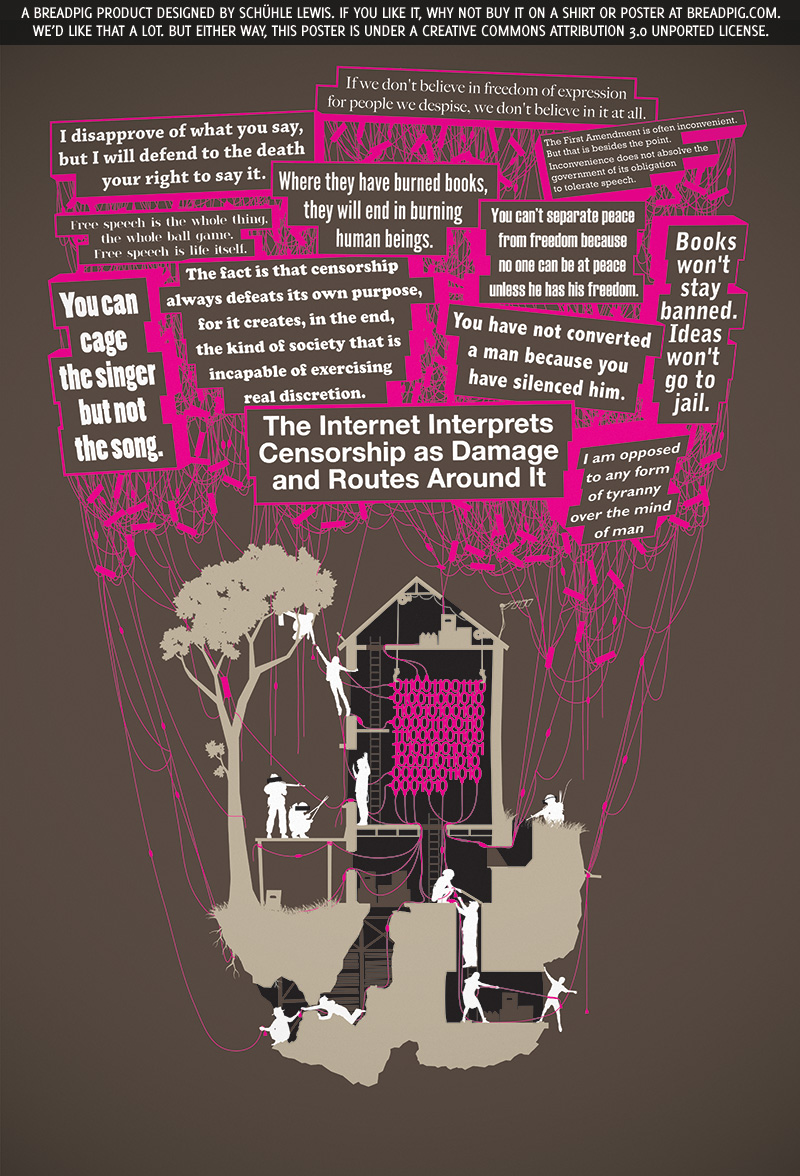
An excellent poster from Schuhle Lewis. Currently hanging in my front hallway.
  • If you like the image above, you can pick it up from the Breadpig Store. 100% of profits go to the Electronic Frontier Foundation, who I would give money to any day of the week. EFF is the leading civil liberties organization defending free speech, privacy, and innovation on the net.
  • The newly updated Derailing For Dummies. One of my favourite redirects for when I'm having a conversation with someone who does Doesn't Get It on issues of privilege. Required reading for social justice conversations on the interwebs, and for commenters on social justice related posts on this blog. Hop to it!
  • And if you're wondering how I can support and organization like the EFF and require that comments this blog maintain a modicum of respect for the full humanity of folks who aren't privileged white men, I give you TigTog's It's not censorship when it's a personal decision over privately owned space. This issue comes up on feminist (and anti-racist, and Marxist, etc etc) blogs a lot. Say it with me now: it's not censorship if it's not being perpetrated by the government. And freedom of speech doesn't equal freedom from criticism. "It's just my opinion" doesn't float with me, folks.