Showing posts with label quick hits. Show all posts

Thursday, January 19, 2012

Quick Hits: Procrastination Edition

It's the early part of the semester here in Ann Arbor, which can mean only one thing: I have tons of work to do, and I'm not managing it as well as I should be. Research and writing have taken over my life, including the times when I'm not actively working on my article. Although last term ate up all my blogging willpower -- it's hard to want to write more words when getting out a pile of them on a specific topic is the only thing on your to-do list for today -- I've decided that keeping things updated is both an effective means of procrastination and a way to take a break from reading past issues of the ASR over, and over, and over, and over.

For those of you who are looking for some good reads to distract you from more important things, I've got a few that should serve just fine:

  • From back in May of this year, Jonathan Franzen on technology and love in the NYT. The article also covers birdwatching and mirrors, but as with any Franzen piece, it's best to let him take you along for the ride:  "To speak more generally, the ultimate goal of technology, the telos of techne, is to replace a natural world that’s indifferent to our wishes — a world of hurricanes and hardships and breakable hearts, a world of resistance — with a world so responsive to our wishes as to be, effectively, a mere extension of the self...Let me suggest, finally, that the world of techno-consumerism is therefore troubled by real love, and that it has no choice but to trouble love in turn." 
  •  A fantastic piece on Anonymous by Gabrielle Coleman in Triple Canopy. Coleman's exactly the right person to be writing about Anonymous -- a professor at McGill University in Montreal, she styles herself an anthropologist of "digital media, hackers and the law". But unlike most writers on the subject, Coleman clearly has an affection for Anonymous and 4chan, the community that sprouted it. It's not often you hear 4chan called "endearing", but it happens here. Also has one of the best explanations of "for the lulz" that I've seen in a more traditional-style publication. 
  •  On the subject of online activism, the SOPA/PIPA protests led to a lot of good links floating around. While most of them were of the "here's why SOPA is bad for the internet" variety -- a statement with which I heartily agree -- I also wound up devouring a few less targeted pieces on intellectual property in general. If you don't mind your politics Left, this piece by sociologist Peter Frase is an excellent parsing of the intellectual property debate, as specifically relates to legislation like SOPA/PIPA: Intellectual Property and the Progressive Bourgeoisie. An unexpected response from the left is here at Mr. Teacup's highly readable blog: Facing the Google Vanguard.

On the subject of Franzen: his recently published collection of essays, The Ecstasy of Influence, is one of a kind. Drawing its title from his fantastic 2007 piece in Harper's (a must-read!), it's got essays on everything from sci-fi to Dylan to clerking in a used bookstore to sex in cinema. On top of that it has two of my current favourite essays, both of which have inspired me to get back to blogging: "What I Learned at the Science Fiction Convention" and "Postmodernism as Liberty Valance". Can't go wrong with titles like that!

Tuesday, May 17, 2011

Quick Hits: I have no internet edition

    What about the people or organizations who have trouble with this concept—such as what happened with Warner Brothers when it started sending cease-and-desist letters to kids who posted Harry Potter fan fiction online? "For entertainment corporations, the lesson should be obvious: don’t threaten a bunch of Web-savvy teens who’ve done nothing wrong. The bigger lesson is, don’t attack the audience for trying to connect with a story you hold the rights to."
  • N+1, fast becoming one of my favourite reviews, has a piece on the devaluing of the humanities in the American university's push toward a neoliberal model of higher education. I'm a fan of Nussbaum and Menand's writing (although not always their conclusions), and this article makes me want to pick up all three books it reviews:
    The budding graduate student has no Paper Chase, no ER, no thrilling fantasy of the intellectual rigors and erotic enticements of professional initiation that would mitigate the shame involved in gaining entry (or re-entry) to middle-classness. Even the few official bureaucratic hoops of a doctoral student — the oral exams, the reading lists — are anticlimactic, presented with a dully comforting reassurance that they’re not really all that frightening. And of course the stories of unpaid rent, half-employment, and the neo-Victorian social struggles of men and women past their first youth have no glamour about them. What is left is a culture of defensive shame: shame about so many things, but mostly about the tremendous gap between exalted goals and humble everyday routines.
I've been in transit the last week or so -- moving into a new apartment -- and have been without internet. This has left me with lots of time to blog and no medium to blog with. Lengthier updates returning soon!

Wednesday, May 4, 2011

Quick Hits: Getting back in the blogging game edition

  • A great video from the Guttmacher Institute on the facts about abortion in the United States. That abortion is primary health care for women should be uncontested -- that it remains contested is often the result of the spread of misinformation over facts, which is why interventions like this are so valuable:

  • A great little piece in the New York Times about the history of book branding. I'm a geek for little facts about things I love -- hearing that Walt Whitman wrote his own glowing, anonymous reviews warms the cockles of my bibliophile heart.
  • Michael Chabon is writing the introduction to Knopf's 50th anniversary edition of The Phantom Tollbooth. When I was a kid, my dad used to read out loud to me and my brother in the evenings; Norton Juster's whip-smart children's classic was one of our all time favourites. Chabon's introduction is excerpted in the New York Review of Books, and well worth the read.
  • Ta-Nehisi Coates has become a mainstay of my RSS feed (if the NYT is looking for someone to replace Bob Herbert, I think he'd be an excellent choice. Here he argues that the American Civil War wasn't tragic -- at least, not in the way it is often portrayed.
  • Margaret Atwood on tweeting: "So what’s it all about, this Twitter? Is it signaling, like telegraphs? Is it Zen poetry? Is it jokes scribbled on the washroom wall? Is it John Hearts Mary carved on a tree? Let’s just say it’s communication, and communication is something human beings like to do". Speaking of which, Textual Relations is now on Twitter! I don't think I've quite got the hang of this tweeting thing yet, but practice makes perfect, right?
  • I'm not usually one for network analysis, but Kieran Healy, writing for Crooked Timber, points out an article in the New Left Review that uses network methods to look at classic literature. That's something I can definitely get behind.
  • Critical interventions in Ursula K. LeGuin, including a great short essay by LeGuin herself on American SF and the Other: "I think it's time SF writers—and their readers!—stopped daydreaming about a return to the Age of Queen Victoria, and started thinking about the future. I would like to see the Baboon Ideal replaced by a little human idealism, and some serious consideration of such deeply radical, futuristic concepts as Liberty, Equality, and Fraternity. And remember that about 53% of the Brotherhood of Man is the Sisterhood of Woman."

In the past two weeks I've: finished my grading, submitted my grades, finished a paper, said goodbye to my lovely American friends, and moved to Halifax for the summer. In light of all of that, my blogging brain needs to be rekindled a little. So I'm taking suggestions -- what would you like to see me blog about?

Thursday, March 17, 2011

Quick Hits

  • Clay Shirky, writing for the always excellent Crooked Timber, on Idealism, Realism and Social Media. The post is particularly interesting to read in light of Malcolm Gladwell's pre-Tunisia, pre-Egypt piece in the New Yorker, The Revolution Will Not Be Tweeted. From the Shirky post: "The North African revolutions and remind us that citizens aren’t so much political or apolitical as they are politicized or unpoliticized at any given moment; even people who don’t like discussing politics in their spare time can turn out in the Tahrir Square when the serious business starts." This is an important distinction to make, and one that is too often lost in the dystopian/utopian arguments that regularly dominate discussions of the effect of the Internet on politics.
  • In the Chronicle of Higher Education, a piece about Lisa Nakamura's recent work on racism in gaming. Examining interaction in Lineage II, Nakamura found that female dwarf characters were popular in-game targets. The reason? Female dwarves avatars are popular among Chinese gold farmers, and those players killing them would often type anti-Chinese slurs into the public chat at the same time. "What happened was that female dwarfs become an unplayable race" in the game, Nakamura said. "They basically became a racial minority," she added, "with the same status as immigrant workers—they become a race, which is an interesting thing."
  • Chally has an interesting conversation going on over at Feministe about the ever present "where are you from" question. Starting with an exploration of the idea of 'fromness' (for lack of a better term), she moves into the more critical question of who is mostly likely to be asked where they're from, as well as who's answers are least likely to be taken seriously (hint: it's not white people).
  • S.E. Smith at Bitch Magazine wants you to think about the -isms in your feminism, particularly in relation to feminist icons. Also from Smith: why she's leaving mainstream feminism (but not the fight for women's rights), and an exploration of television before and after Sept 11.
  • From Geekosystem: the Social Science Research Council has released a study that argues digital piracy is better understood as a global pricing problem. It's nice to see a study that takes seriously the connections between economic well-being and access to software, particularly in an international way.

Finally, Textual Relations now has a Facebook page! 'Like' it to get notifications when the blog is updated, as well as other interesting tidbits from around the web.

Saturday, February 19, 2011

Quick Hits: the GOP hates women edition

The following bills have recently been put on the table (and then occasionally shelved, hallelujah) by various state and federal Republican representatives:

  • The proposed GOP budget cuts for fiscal year 2011 mean a drastic decrease in funding for domestic violence prevention programs; this includes the elimination of the Violence Against Women Health Initiative and the Engaging Men and Youth in Prevention programs, as well as a $7 million cut to Family Violence Prevention and Services Act, which funds domestic violence shelters and the national hotline for domestic violence victims. 
  • The "Title X Abortion Provider Prohibition Act", introduced by Representative Mike Pence (R-IN) would amend the Public Health Services act to prevent any organization that provides abortions--except in cases of incest, rape, or when the woman's life is endangered--from receiving family planning grants. Under the existing Act, Title X funds are not used on abortion services, but on family planning and preventative health initiatives. The change to this act would effectively defund Planned Parenthood. The House has voted in favour of the act.
  • H.R.3 and H.R.358 are both on the table in the House. H.R.3, the "No Taxpayer Funding for Abortion Act", originally sought to redefine rape (this has since been removed from the bill), and strong arms insurance companies into not covering abortion services, as well as imposing a tax burden on small businesses that purchase plans that cover abortion. H.R.358, the "Protect Life Act", carries a provision that would allow health care providers to deny live-saving abortion care to women with dangerous pregnancies. It also bans insurance coverage of abortion in the new health care system.
  • The Ohio State Legislature recently tabled a "Heartbeat Bill", which would ban abortion after a heartbeat is detected in the fetus. The heart is one of the first organs to develop in a fetus, and heartbeats are detectable between eighteen days and six weeks into the pregnancy. The presence of a heartbeat does not indicate viability. If passed, the bill would likely provide an avenue for a Supreme Court challenge of Roe v. Wade.
  • Meanwhile, the South Dakota Legislature has (thankfully) shelved a bill that would have rendered as "justifiable homicide" those murders in service of protecting an unborn child. In a country that has seen the murder of abortion providers and the bombing of abortion clinics, this is clearly a concern. From the NYTimes article: "Dave Leach, an Iowa anti-abortion activist, praised the bill, saying it could end abortions in South Dakota by scaring away doctors or by establishing grounds for someone to kill those who stay.'There may be something I’m overlooking, but from all appearances, this bill would certainly justify an individual taking the life of an abortionist in order to save human lives,' he said."
  • Melissa McEwan, on the bullshit that is the anti-choice position: "No one can argue, with any honesty or credibility, that they give a fuck about the sanctity of life if they would force a woman to carry to term an unwanted or unviable pregnancy against her will. That is the opposite of a respect for life, if the definition of "life" is to have any meaning at all."

Tuesday, February 1, 2011

Quick Hits

  • Phillip Pullman (author of the His Dark Materials trilogy) defends public libraries in the face of funding cuts in the UK: "No-one else can get in the way, no-one else can invade it, no-one else even knows what’s going on in that wonderful space that opens up between the reader and the book. That open democratic space full of thrills, full of excitement and fear, full of astonishment, where your own emotions and ideas are given back to you clarified, magnified, purified, valued. You’re a citizen of that great democratic space that opens up between you and the book. And the body that gave it to you is the public library. Can I possibly convey the magnitude of that gift?"
  • Turns out Vladimir Nabokov wasn't just one of the most beautiful writers of the the past century. He was also a self-taught lepidopterist, and his theories about butterfly evolution were recently confirmed by Harvard scientists.
  • An excellent post on the historical intersections between slavery and abortion, and a wonderful response to the right-wing rhetoric that equates a woman's right to choose with the institutionalized subjugation of Black Americans.
  • Ta-Nehisi Coates hosts Brendan Koerner's essay on the future of reading. In the same vein, John McPhee in the Paris review on the future of writing.
  • Margaret Atwood has an upcoming book on science fiction and the human imagination. Must. Have. Although it's unclear if this means she's backing off her eternal distinction between SF and speculative fiction.
  • From the BBC, an interesting interview with Ursula LeGuin. She discusses how social anthropology has influenced her writing, among other things.
  • And finally, check out this 1994 Today Show clip (and Katie Couric's magnificently terrible hairstyle) as we ask that age-old question: What IS the Internet? The future is now guys!

Tuesday, January 11, 2011

Quick Hits

Scientific history-writing, Bailyn writes, is always skeptical and problematic; it questions itself constantly and keeps its distance from the past it is trying to recover. By contrast, memory’s "relation to the past is an embrace. It is not a critical, skeptical reconstruction of what happened. It is the spontaneous, unquestioned experience of the past. It is absolute, not tentative or distant, and it is expressed in signs and signals, symbols, images, and mnemonic clues of all sorts. It shapes our awareness whether we know it or not, and it is ultimately emotional, not intellectual".
  • This month's Advocate has a cover story on Hillary Clinton and LGBT rights, which is worth the read.
  • Bob Herbert, whose NYT column I've been enjoying more and more over the last few months, on the violence of American culture: "If we were serious, if we really wanted to cut down on the killings, we’d have to do two things. We’d have to radically restrict the availability of guns while at the same time beginning the very hard work of trying to change a culture that glorifies and embraces violence as entertainment, and views violence as an appropriate and effective response to the things that bother us." One of my favourite authors, Lonesome Dove's Larry McMurtry, on the same subject.

Tuesday, December 14, 2010

Quick Hits


The selection of NSF as the first target will send a chilling message to researchers. The YouCut Citizen Review site includes a link to the NSF's Award Search site, and a form for people to submit examples of offending projects.

'If you find a grant that you believe is a waste of your taxdollars [sic], be sure to record the award number,' participants are told. '[W]e will publish a report outlining the grants identified by the YouCut community.

The suggested search terms – 'success, culture, media, games, social norm, lawyers, museum, leisure, stimulus' – and the contrast drawn between 'worthy research in the hard sciences' and 'questionable projects' hint that researchers funded by the NSF's Directorate of Social, Behavioral and Economic Sciences have the most to fear.

Sunday, December 5, 2010

Quick Hits: tooling around on the internet edition

  • Chuck Klosterman's NYTimes piece on How Modern Life is Like a Zombie Onlsaught has been making the rounds on Facebook this morning. In a piece packed full of cultural insights, this one may have been my favourite: "Zombie love, however, is always communal. If you dig zombies, you dig the entire zombie concept. It’s never personal. You’re interested in what zombies signify, you like the way they move, and you understand what’s required to stop them". 
  • Early on in the Klosterman piece was a link to Alice Gregory's Sad As Hell in the literary mag n+1. While I am generally not a fan of "the internet is ruining society foreverrrr", I do enjoy a good piece of criticism on the subject of digital life. This falls into that category for me, as does an earlier NYTimes article by Gary Shteyngart, the author of the novel reviewed in Sad As Hell. 
  • And, just because I find it entertaining, check out the book most often purchased in combination with n+1's What Was the Hipster on Amazon. 
  • This makes me want to move to San Francisco
  • Garland of Tiger Beatdown (one of my very favourite feminist blogs) on the Privilege Denying Dude meme: "In social justice, not all tactics that are divisive are effective, but all tactics that are effective are divisive. That doesn’t mean we should set our phasers to “divide,” but when a tactic is labeled as “divisive” or “radical”, there is a chance it might be one worth considering. Effective tactics are divisive because the majority is most comfortable with activism that is ineffective." 
  • Sady, whose baby Tiger Beatdown truly is, also on the Privilege Denying Dude Meme: "It’s not like there are no problems with Privilege Denying Dude; our tendency to oversimplify ideological opponents is something I’ve spoken at tiresome length about, whilst being treated like an extremist bitch who subsists on a diet of sensitive dudes’ testicles and wants to personally come over to your house and burn everything you love and yell at you until you cry burning hot tears of shame...But at a certain point, you can’t hold enough public symposiums about your inner conflicts and your ideas about responsibility and your intentions. You can’t ever apologize enough; you can’t ever be careful enough; you can’t ever make enough Sympathy Faces and phrase enough statements as questions and say “that’s a reasonable point, but” enough, because there are always people who want to listen until it turns out they’re implicated." 

Wednesday, November 24, 2010

Quick Hits

Sunday, October 10, 2010

Quick Hits

  • An interesting take on The Social Network over at the New Statesman: "The territory of this modern parable is precisely objectification: not just of women, but of all consumers. In what the film's promoters describe as a "definitively American " story of entrepreneurship, Zuckerberg becomes rich because, as a social outsider, he can see the value in reappropriating the social as something that can be monetised. This is what Facebook is about, and ultimately what capitalist realism is about: life as reducible to one giant hot-or-not contest, with adverts."
  • David Simon, creator of The Wire, wins a MacArthur Genius Grant. Two and a half seasons into the show, and I can completely see why. It's some of the best television I've ever seen -- it might actually be the best ever made. But what I like about it most is the same thing I liked about HBO's Deadwood (and, every once in a while, about Battlestar Galactica): it's good sociology. I've got a post in the works about The Wire and Althusser's ideological state apparatuses. Stay tuned.
  • Spent the evening tonight watching the classic documentary Harlan County, U.S.A. It's one of the more brilliant docs I've seen, and really throws light on labour struggles in the United States. Criterion has an excellent essay up on the film, which situates it as a progenitor of the contemporary political documentary. The film is available streaming on Hulu & Netflix, so no excuse not to watch it. But if you need more convincing:


Thursday, September 30, 2010

Quick Hits: Tea Party Edition


  • A Matt Taibbi piece in Rolling Stone: "Vast forests have already been sacrificed to the public debate about the Tea Party: what it is, what it means, where it's going. But after lengthy study of the phenomenon, I've concluded that the whole miserable narrative boils down to one stark fact: They're full of shit."
  • Jane Mayer's New Yorker piece on Tea Party funding sources: "At one rally, an effigy of a Democratic congressman was hung; at another, protesters unfurled a banner depicting corpses from Dachau. The group also helped organize the 'Kill the Bill' protests outside the Capitol, in March, where Democratic supporters of health-care reform alleged that they were spat on and cursed at.
  • My Country, Tis of Me, from The Atlantic: "Some people think that what unites the Tea Party Patriots is simple racism. I doubt that. But the Tea Party movement is not the solution to what ails America. It is an illustration of what ails America."

Thursday, September 23, 2010

Quick Hits

  • An excellent round of up Abagail Nussbaum's posts on Star Trek: Deep Space Nine, my favourite and, in my opinion, the best of the Treks, and one of the most thoughtful treatments of religion on a sci-fi show that I've seen (eat your heart out, Battlestar Galactica).
  • The .DOC File of Alfred J Prufock, by copperbadge. One of the many examples of why the internet is one of my favourite things. Be sure to check the comments for the William Carlos Wilson version of a thank you comment.
  • Courtesy of a friend in the department who knows me quite well, The Anthropology of Hackers in The Atlantic. Love the syllabus-as-article format, and I think the use of both Martha Nussbaum and the concept of spectacle in a class on hackers is fantastic. I wish more classes on trendy-techy subjects would reach back for help from their intellectual predecessors.
  • An excellent collection of links commenting on the most recent iteration of RaceFail/Cultural Appropriation Debate of DOOM. If you don't know RaceFail, the two previous links give you more information than you could get through in a month, but suffice to say it was the moment fandom confronted race head on and changed the discussion in a challenging, often infuriating and heartbreaking way. Suffice to say that this iteration starts in the same place, and that middle-to-big name professional sci-fi and fantasy writers should take a long hard look at themselves before they decide to pontificate on entire groups of people.
  • Re-imagine Music is releasing a tribute album to Dylan's Bringing it All Back Home on October 5th. It has Julie Doiron, Ane Brun, The Morning Benders, Sea Wolf, and Laura Veirs. I'm practically oozing anticipation.
  • Immanuel Kant attack ad (I know enough about Kant to know that it's funny. Which is very little indeed):


Sunday, September 19, 2010

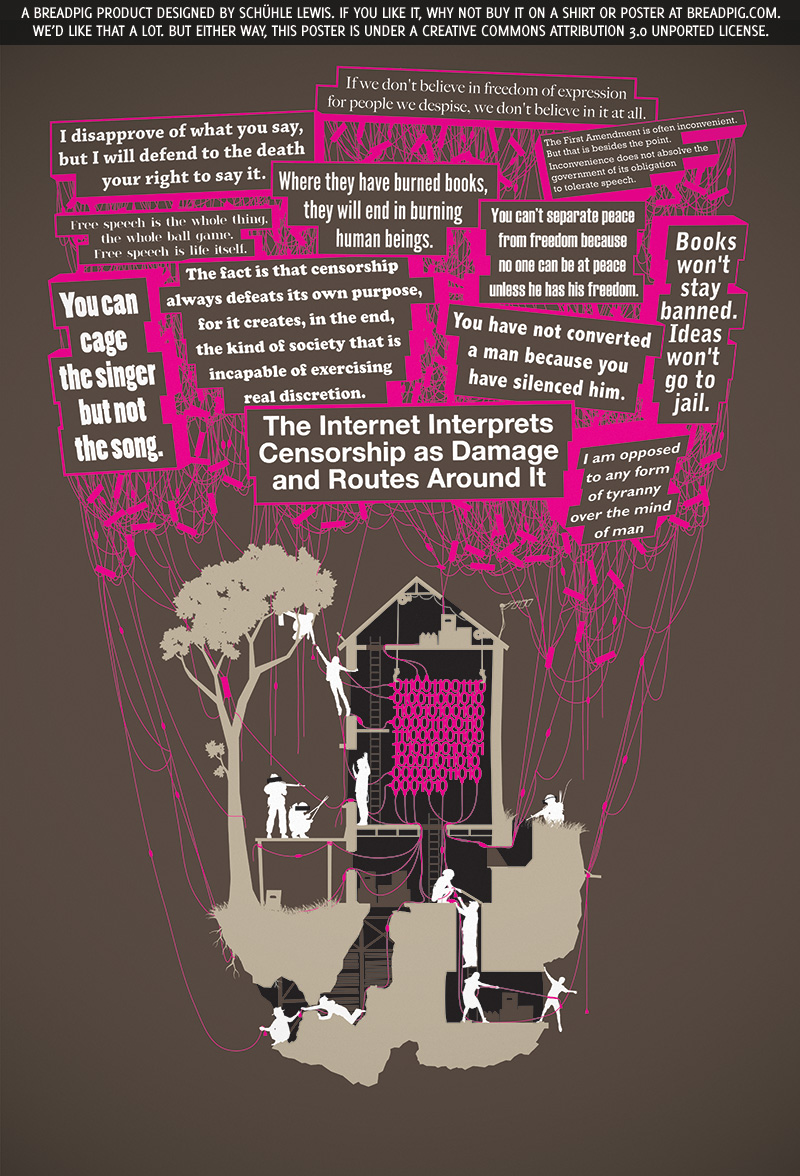
Quick Hits: censorship and free speech online

An excellent poster from Schuhle Lewis. Currently hanging in my front hallway.
  • If you like the image above, you can pick it up from the Breadpig Store. 100% of profits go to the Electronic Frontier Foundation, who I would give money to any day of the week. EFF is the leading civil liberties organization defending free speech, privacy, and innovation on the net.
  • The newly updated Derailing For Dummies. One of my favourite redirects for when I'm having a conversation with someone who does Doesn't Get It on issues of privilege. Required reading for social justice conversations on the interwebs, and for commenters on social justice related posts on this blog. Hop to it!
  • And if you're wondering how I can support and organization like the EFF and require that comments this blog maintain a modicum of respect for the full humanity of folks who aren't privileged white men, I give you TigTog's It's not censorship when it's a personal decision over privately owned space. This issue comes up on feminist (and anti-racist, and Marxist, etc etc) blogs a lot. Say it with me now: it's not censorship if it's not being perpetrated by the government. And freedom of speech doesn't equal freedom from criticism. "It's just my opinion" doesn't float with me, folks.

Tuesday, September 14, 2010

Quick Hits

Things on the Internet that I have recently enjoyed and/or learned from:


  •  A cappella prep version Bitches Ain't Shit by Dr Dre. It's technically a version of the Ben Folds cover, but this one made me laugh so hard the first time I saw it.
  • An excellent post on Crooked Timber about hyperlinks, research, and cognition. Has me thinking about the relationship between footnotes and links as both references and content-carriers.
  • Canadian retailer Jacob announces that its ads will not longer feature retouched models. Hooray for a  semblance of body positivity! Next step: getting some body diversity in there too.
  • Margaret Atwood is one of my favourite writers -- particularly her short stories and poetry. This Recording reposted a 1976 essay from her on the subject of women and writing. It reminded me of Joanna Russ' brilliant and oft-cited (by me) How to Suppress Women's Writing. Both highly recommended.
  • Hipster Shrugged: The Twitter Meme. Probably the only worthwhile thing to come out of Ayn Rand.
  • From the always enjoyable Big Picture: Russia, in colour, a century ago. Beyond being utterly cool, this got me thinking about the way we relate images to time. Because they look like photos that could have been taken now, the pictures were, for me, difficult to place in their historical context.  Colour serves not only as a representation of what was, but also as a temporal marker. You can see this with the contemporary obsession with sepia tone, with black and white, and now with Polaroid-style shots and disposable cameras. The images themselves aren't nostalgic, but the colour makes them so.
  • Copyright and booze. An incongruous match, both for studying and for drinking.
  • And finally -- Take a look at the following image. You get three guesses as to what it represents:


...if you guess a high school sexual network, you were right! The link is way old, but the information is still relevant -- because teenagers use the "don't date the ex-boyfriend of the current girlfriend of your own ex" rule in choosing their partners, they end up forming chain where they're linked to almost every other sexually active member of the school. Implications for STI-transmission (and major drama) are obvious.