Wednesday, January 26, 2011

Genna Kusch's art of the imagination

"I, said the Sparrow, with my bow and arrow..."
Multi-part woodcut, 2009
Over the last few years, I've had the pleasure and the privilege of talking about art and literature--among a host of other things--with Genna Kusch, a Canadian artist currently living and working in Scotland. The first person ever to discuss with me about the politics of curating and displaying art in a museum, and always willing to spend a few hours over drinks talking about CBC radio podcasts, Kusch's work has been inspiring me for years to rethink my attitudes towards children's literature in general, and animal stories in particular. Her art takes up the themes of wildernesses, found both in the mind and the heart as well as right outside our doorsteps. Working primarily in print, Kusch situates her pieces firmly within the tradition of  illustration that recalls the beautiful books we remember from childhood.

Kusch's art draws on the stories and rhymes that make up the children's literature canon in the Western world. Referencing sources as diverse as the nursery rhyme "Who Killed Cock Robin?", the popular French Canadian children's song "Alouette", and the always beloved Peter Pan, her recent work explores the fantasies and dangers of the child's engagement with nature.

In her artist statement, Kusch cites my always-favourite essayist on, and writer of, fantasy literature, Ursula K. LeGuin. In her lengthy piece on animals in children's literature (reproduced in Cheek by Jowl) LeGuin explores our tendency to give books about animals to children:
In postindustrial civilization, where animals are held to be irrelevant to adult concerns, animal story is mostly perceived as being for children...
It appears that we give animal stories to children and encourage them to be interested in animals because we see children as inferior, mentally 'primitive', not yet fully human: so pets and zoos and animal stories are 'natural' steps on the child's way up to adult, exclusive humanity--rungs on the ladder from mindless, helpless babyhood to the full glory of intellectual maturity and mastery. Ontology recapitulating phylogeny in terms of the Great Chain of Being.
But what the is it the kid is after?...What is it that the child perceives that her whole culture denies?
It is this question that Kusch's work takes up. In her twin pieces "Last Night's Child" and "Tonight's Child", she draws out the fantastical fears that compel us both to flee from and linger with stories like Red Riding Hood:

Last Night's Child and Tonight's Child
Lithographs, 2009

In these images the wilderness colonizes the body of the child, but it is unclear what makes this notion horrifying: the prospect that she has become a monster, or the possibility that she has been one all along? This engagement with the dark side of childhood is also evident in her wall-sized multi-part woodcut, At the Playground:
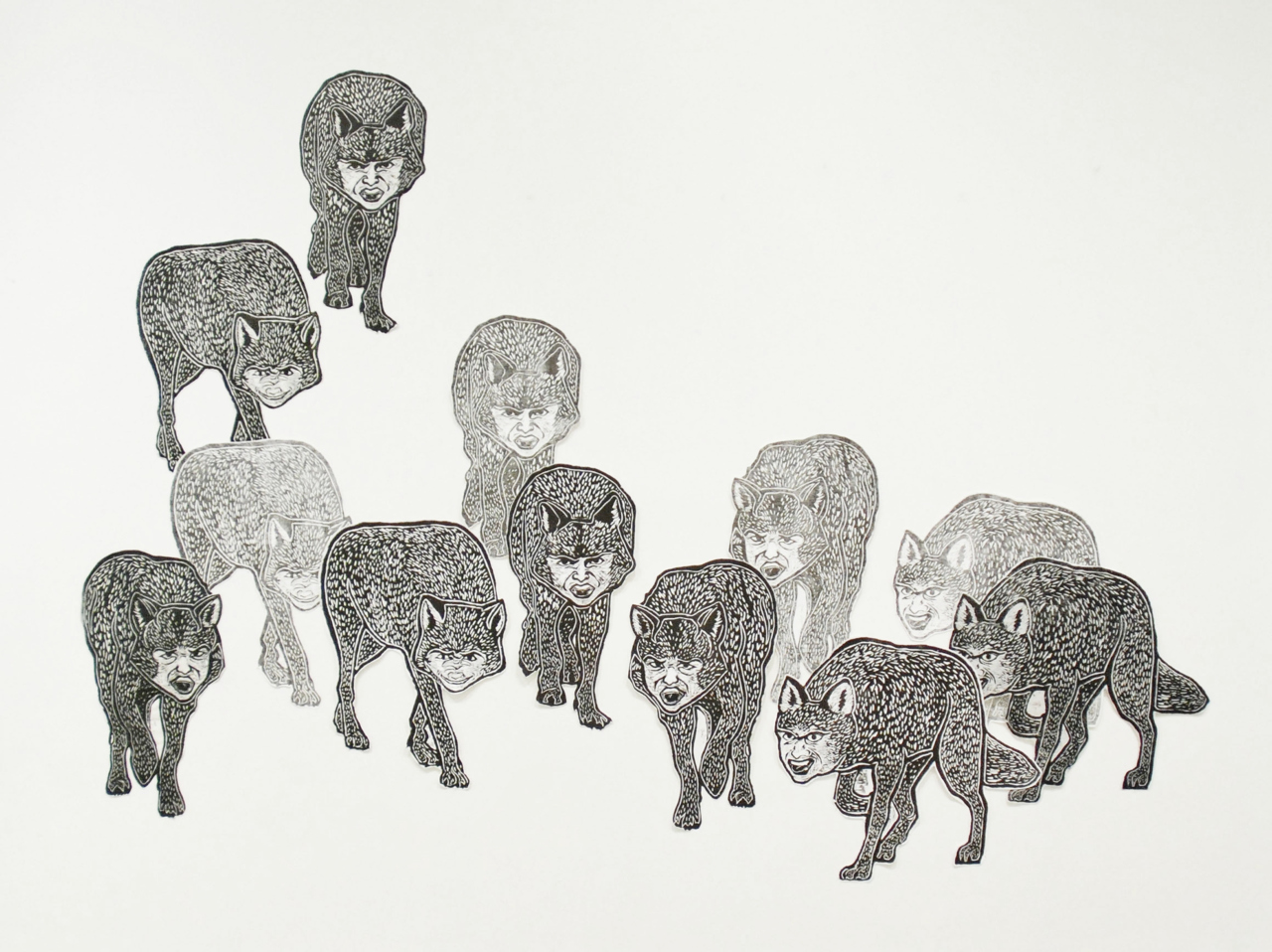

At the Playground
Multi-part woodcut, 2009
Here, the faces of the wolves are replaced by the faces of children, wearing the taunting, mocking expressions that so often form the content of the wilderness of youth. Kusch's artistic response to the question posed by LeGuin--what is it that the child perceives that her whole culture denies?--is that stories about animals are also stories about people; that children can be like wolves stalking the forest, or like girls who shift between child and beast.

The relationship of the idea of wilderness to childhood was brought to the forefront recently in Michael Chabon's essay "The Wilderness of Childhood". Childhood, he argues, "is a branch of cartography":
Childhood is, or has been, or ought to be, the great original adventure, a tale of privation, courage, constant vigilance, danger, and sometimes calamity. For the most part the young adventurer sets forth equipped only with the fragmentary map—marked here there be tygers and mean kid with air rifle—that he or she has been able to construct out of a patchwork of personal misfortune, bedtime reading, and the accumulated local lore of the neighborhood children.
LeGuin also makes use of the mapmaking metaphor in her rebuke of critics who discount the value of fantasy:
The monstrous homogenization of our world has now almost destroyed the map, any map, by making every place on it exactly like every other place, and leaving no blanks. No unknown lands...In reinventing the world of intense, unreproducible, local knowledge, seemingly by a denial or evasion of current reality, fantasists are perhaps trying to assert and explore a larger reality than we now allow ourselves. They are trying to restore the sense...that there is somewhere else, anywhere else, where other people may live another kind of life.
Kusch's work is a part of this cartography of the fantastic, the filling in of the imaginary characters of the very real terrors of children's lives. Not all of her work brandishes this element of horror, but it lurks in the background of even her earlier paintings: insects crawl on translucent hands, bones and masks shroud faces in mystery. Ultimately, though, these woodcuts and etchings offer a semblance of reassurance. Not the shallow comfort of nostalgia or the poorly concealed anxiety of helicopter parenting, but the fortitude that comes from a confrontation with the fact that no matter how we try to quash them, we all have our wildernesses, and we all must face them with the courage of a child at play.

Tuesday, January 25, 2011

Black Swan and the terror of femininity

Last night, after a long conversation with a friend of mine, I finally realized why I came out of Black Swan feeling frustrated, rather than pleased. On the surface, Aronofsky's latest is a film I should enjoy -- it melds the real with the hyperreal, features excellent performances and beautiful art design, and is a film about the horrors of being female, represented by that most feminine of creatures, the ballerina.

Or is it? After the first half of the film, I was relatively convinced that I was watching a horror movie about the terrors of femininity; by the final third I realized that was not the film I was watching at all. All of the archetypes were there--the lecherous mentor, the beautiful rival, the overbearing Freudian mother, the aging diva. Many of the motifs of a threatening womanhood were there too. A syrupy pink bedroom, the smothering presence of mirrors. Injured feet and toes, references to and representations of self-harm. All in service of that most perfect of feminine icons: the ballerina.

The early parts of the film seem to support this interpretation. Nina (Natalie Porman) is a young woman--how old exactly, we have no idea--who longs for the part of the Swan Queen in Swan Lake. We have no clear idea about why she wants this role; she seems to have no artistic impulses to speak of, and beyond the pressure of her mother and the fact that every young ballerina in the world wants to be the Swan Queen, Nina's desire for the part has no clear motivation. This is not a failure on Portman's part. The character has clearly been designed to be empty of the idiosyncratic motivations that would make her a real person. She is, instead, The Ballerina, the ultimate symbold of controlled, naive, feminine perfection.

Aronofsky's film has been criticized in some circles for being sexist. The story of a naive girl who just needs to find her sexuality so she doesn't become a frigid failure like her mother is not a particularly empowering one, to be sure. In its defense, however, Black Swan is clearly a story filled with archetypes. That we are not to take these characters seriously as real, fragile human beings is clear from the start. Black Swan is not fundamentally about Nina, as a character. It is about The Ballerina, as a symbol. The question, then, is what does the ballerina represent? If Black Swan is a parable, what is the moral?

Despite being a film that makes use of so many of the tools of feminine terror, this is a surprisingly difficult question to answer. Nina's confrontations--with her sexuality, in the form of her choreographer and her rival, and with her womanhood, embodied in her mother and Winona Ryder's prima ballerina well past her prime--are the archetypal confrontations of womanhood. That Black Swan is a primarily a horror movie does not detract from this. The body horror central to the film's artistic direction points towards female embodiment. There are lingering camera shots on damaged or deformed toes and feet; the physical sacrifice Nina makes to become the perfect ballerina parallels the difficulties inherent in wearing high heels to become the perfect woman. Mirrors are everywhere in the film, and always oppressive. They reveal error and digust, rather than beauty.

Most salient, in my eyes, was the repeated reference to self-injury. It is established early on that Nina has strange cuts on her shoulders, from whence her black wings will eventually emerge. But the conceit of the film is that these cuts could have been caused by Nina's propensity to scratch herself. Her mother mentions this multiple times, and is even portrayed  as having developed strategies to deal with it. Much of the early body horror in the film is obsessively focused on nails and cuticles, areas of the female body particularly subject to self-harm. As the tension around Nina builds--she is sexually harassed by her mentor, repressed by her mother, and jealous of her more openly sexualized rival--the scratches worsen. Here is a woman confronted by the terrors of womanhood, terrors written on her body in places and styles traditionally associated with feminine horror.

At a certain point in the movie, Nina, having recently overcome her sexual reticence, is seated alone on a subway, across from an old man. As he watches her, he licks his lips lasciviously and begins to masturbate while they travel. Nina barely movies. What purpose does this sequence have, if not to represent the ultimate fear that comes with femininity: that you will be trapped in an inescapable space with someone who sees you only as a body to use and desire?

So where does this leave us, as we walk out of the theater? In the end, Black Swan is a frustrating experiment in genre and in theme; it squanders its opportunity to be a genuinely terrifying film about the anxieties of femininity, choosing instead to be a rather mediocre horror movie that, by the end, has descended into camp. Aronofsky's technical achievements are remarkable, the performances beautiful, and the art direction extremely strong in developing the theme laid out. The problem with Black Swan is that it chose the wrong theme, and, in doing so, missed its chance the achieve something truly, deeply, and magnificently horrifying.

Sunday, January 23, 2011

Grupo Corpo

I have a post in the works about feminism in the films of Hayao Miyazaki, but in the interim, I wanted to share this beautiful video of Brazil's Grupo Corpo dance troupe:


Although I didn't have the opportunity to see them, the acclaimed group performed yesterday at Power Center for the Performing Arts in at the University of Michigan. Drawing on Brazilian music for inspiration, the dance company performs pieces that blend the exquisite control of ballet with the dynamism and verve of modern dance. Both elegantly lyrical and richly erotic, the piece embedded in this post displays an attention to the details of human sexuality rarely visible in more widely popular forms of dance. Grupo Corpo is not to be missed.

Friday, January 21, 2011

Egon Schiele


Everything is blooming most recklessly; if it were voices instead of colors, there would be an unbelievable shrieking into the heart of the night. -- Rainer Maria Rilke

Swing Time

Just got back from seeing Black Swan. Thoughts on the film will come in a later post, but I will say that throughout the movie I lamented the fact that, in order to cover up the fact that Natalie Portman is not, in fact, a ballerina, the camera needed to be movie consistently. I long for the days when the dynamism was in the dance, and not in the cinematography.

On that note, I ended up plunking myself in front of the computer to watch two hours of dance videos on YouTube. A veteran fan of So You Think You Can Dance, I spent a while re-watching some of my favourites, but eventually made the transition to the great dance sequences of musicals past. Although completely different in tone the choreography of Black Swan, you can never go wrong with a little Fred and Ginger on a Thursday night: